Why Video Lectures Aren't Enough: The Role of Correction Sheets in Clearing ACCA Professional Levels
5/22/2026
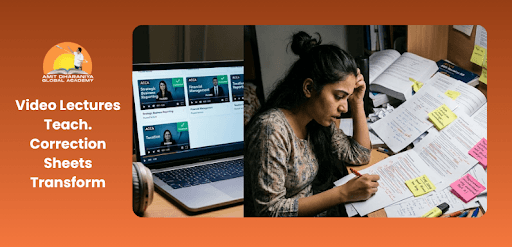
Many ACCA students begin their journey believing that watching lectures is the same as studying.
It feels productive. The classes are detailed. Notes are available. The faculty explains concepts clearly. After finishing a three-hour lecture, students often feel like they have “covered” the topic properly.
But then something unexpected happens during ACCA Professional Levels.
The student sits down to solve a Strategic Professional question independently, but suddenly struggles to structure their answer. The concepts feel familiar, but applying them under exam pressure becomes difficult. Marks stay stuck despite hours of watching lectures.
This is where many students realise an important truth about ACCA exam preparation.
Professional-level ACCA papers are not cleared by passive learning alone. They are cleared through correction, application, and repeated improvement.
That is exactly where correction sheets become powerful.
The Biggest Mistake Students Make During ACCA Preparation
Most students entering the ACCA Professional Levels already know how to attend classes. What they often do not know is how to analyse mistakes.
This becomes a major problem in papers like Strategic Business Reporting (SBR) and Strategic Business Leader (SBL), where presentation, professional judgement, answer structure, and application matter as much as technical knowledge.
A student may watch 10 lectures on IFRS adjustments and still lose marks if the answer lacks clarity, prioritisation, or a proper explanation. Another student may know the concept but fail to present it professionally within the time limit.
This is why simply consuming content is not enough.
Professional-level ACCA exams test decision-making under pressure. They test how well students think, structure, and communicate. Those abilities improve only when students actively review their own mistakes.
That process is what correction sheets are designed for.
What Exactly Are Correction Sheets?
A correction sheet is not just a notebook where students rewrite wrong answers.
A proper correction sheet is a learning system.
Whenever a student solves a mock test, sectional paper, or practice question, every mistake is analysed carefully. The student records:
- Why did the mistake happen?
- Which concept was misunderstood?
- Whether the issue was technical knowledge, presentation, time management, or interpretation.
- What the ideal approach should have been?
Over time, this creates a personalised database of weaknesses.
That is powerful because no two ACCA students struggle in the same way. One student may repeatedly lose marks in professional ethics. Another may struggle with time allocation. Someone else may know concepts but write weak conclusions.
Video lectures cannot diagnose these patterns.
Correction sheets can.
Why This Matters More in ACCA Professional Levels
The gap between the Skills level and ACCA Professional Levels surprises many students.
Earlier papers often reward preparation through repetition and technical understanding. But professional papers demand maturity in thinking.
For example, in SBL, two students may know exactly the same concepts. Yet one scores significantly higher because the answer sounds more professional, practical, and business-oriented.
That difference usually comes from review and correction, not from watching more lectures.
This is why students who rely solely on recorded content often plateau. They continue studying for long hours, but keep repeating the same answer-writing mistakes.
Professional growth happens when students stop asking: “How many lectures did I complete?”
And start asking: “Why did I lose marks here?”
That mindset shift changes performance dramatically.
Why Mentorship Matters Alongside Correction
Correction sheets become far more effective when mentors actively review them.
Students often cannot identify bigger mistakes on their own. Sometimes the issue is not technical accuracy but thought process, prioritisation, or exam temperament.
That is why mentorship plays such a critical role during ACCA Professional Levels.
At Amit Dharaniya Global Academy, the focus extends beyond lectures into mentoring, practical insights, and structured guidance designed around real exam behaviour. Students are trained through disciplined learning systems in which feedback and continuous improvement are integral to the preparation process.
This creates accountability.
And accountability often becomes the difference between students who stay stuck for years and students who clear papers steadily.
Watching More Lectures Is Not Always the Solution
One common habit among ACCA students is restarting entire classes after a poor mock test result.
The logic feels reasonable:
“If I scored badly, I probably need more lectures.”
But in many cases, the student already understands the concept. The real issue lies elsewhere:
Weak application
Poor time management
Lack of answer structure
Incomplete interpretation of requirements
Rewatching lectures repeatedly can sometimes create a false sense of comfort without solving the actual problem.
This is why students preparing for ACCA Professional Levels should balance content learning with active review systems.
A two-hour correction review session may improve performance more than six additional hours of passive watching.
Why Students Trust Amit Dharaniya Global Academy
Clearing ACCA Professional Levels requires much more than access to lectures. Students need mentorship, correction, accountability, and structured preparation systems that gradually develop professional thinking.
That is exactly why students across India choose Amit Dharaniya Global Academy.
Under the guidance of Amit Dharaniya, India’s first IFRS corporate trainer, ADGA focuses on disciplined preparation, personalised mentoring, practical understanding, and continuous improvement. Students are trained not only to understand concepts but also to perform under exam conditions with confidence and clarity.
The academy’s structured batch model, mentorship-driven environment, and focus on professional readiness help students move beyond passive studying and toward real ACCA success.
If you want to understand how strategic mentoring and structured correction can improve your ACCA performance, book a counselling session with ADGA today and take the next step toward becoming a globally recognised finance professional.
🚀 Ready to Start Your ACCA Journey?
Join Amit Dharaniya Global Academy today and get access to world-class mentorship, flexible learning, and guaranteed placement support.
Book Demo