Starting ACCA in 11th vs. After Graduation: A ₹20 Lakh Difference in Career Lifetime Value
5/15/2026
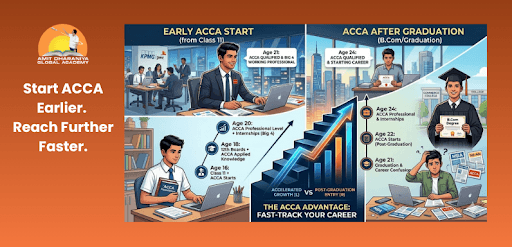
In many Indian households, career planning still follows a very traditional sequence. First comes school, then graduation, and only after that do students begin thinking seriously about professional qualifications. That is why many students discover ACCA only during B.Com or after completing their graduation. By that stage, they are already 21 or 22 years old and trying to figure out placements, career direction, or plans for studying abroad.
But over the last few years, a different pattern has begun to emerge. Students are beginning ACCA much earlier. Some begin their preparation immediately after Class 10 through foundation-level pathways, while others start during Class 11 and continue alongside school and college. The difference this creates by the age of 24 or 25 is not small. In many cases, it becomes a difference worth more than ₹20 lakh in long-term career value.
The important point here is not just salary. It is timing, work exposure, confidence, and how early a student enters the professional world.
The Real Difference Is the Career Timeline
Most parents compare courses based on fees, syllabus, or duration. While those things matter, professional qualifications work very differently. In careers like accounting and finance, the timing of a student's entry often has a direct impact on how quickly they grow.
A student pursuing ACCA after graduation usually begins serious preparation around age 21 or 22. Even with exemptions, the student may complete the qualification around 24 or 25. By that time, they are just beginning their first full-time professional role.
Now compare that with a student who starts ACCA after 10th or during Class 11. These students often complete multiple ACCA papers before graduation. Some even become ACCA affiliates by the age of 20 or 21 while simultaneously finishing B.Com. That changes everything.
By the time one student is attending interviews for entry-level positions, the other may already have two to three years of work experience, stronger communication skills, industry exposure, and a much better salary bracket. That gap keeps increasing with time because professional growth compounds year after year.
Why Students Who Start Early Progress Faster
Students who begin ACCA earlier usually have one major advantage. They are not trying to “restart” their academic discipline after college fatigue has already set in. Instead, they gradually develop the qualification during their most focused learning years.
This is one reason why structured mentoring becomes extremely important. At ADGA, students are trained through a disciplined batch system in which papers are completed using a fixed roadmap rather than random attempts. The goal is not simply to finish exams quickly but to build consistency and professional maturity from an early stage.
Students who start early usually gain several practical advantages. They become comfortable with exam pressure sooner. They improve their communication skills gradually. They gain confidence in interviews earlier. Most importantly, they enter internships and finance roles at a younger age compared to students who begin later.
When this happens consistently over three or four years, the career gap becomes very visible.
Understanding the ₹20 Lakh Difference
Let us take a simple example that many Indian parents can relate to.
Imagine two students from Chandigarh. Both are equally capable academically. One starts ACCA during Class 11. The other decides to complete a B.Com first, then begin ACCA after graduation in India.
The first student completes multiple ACCA papers alongside college, gains internship exposure early, and enters the workforce around the age of 21. By 24, that student may already be working in a Big 4 environment or a multinational finance role with two to three years of experience.
The second student, meanwhile, may still be completing papers or entering their first associate-level role around the same age.
Now look at the financial impact. The early starter may already be earning ₹12-₹20 LPA, depending on the role, location, and practical exposure. The graduate starter may still be in the ₹5-₹8 LPA range while continuing exams and building initial experience.
That difference alone, over three to four years, can exceed ₹20 lakh. But the bigger impact comes later. Promotions happen earlier. Managerial responsibilities arrive sooner. International mobility opens faster. The student who started earlier spends more years earning at senior-level salaries.
This is why the conversation around ACCA after 10th is becoming increasingly common among families looking for long-term career growth.
ACCA Is No Longer a “Backup Option”
Earlier, many students treated ACCA as something they would “try later” if other plans did not work out. That mindset is changing rapidly.
Today’s students want career direction earlier. Parents also want clarity because traditional study-abroad pathways have become extremely expensive. Spending massive amounts on overseas education without guaranteed outcomes worries many middle-income families.
This is where ACCA becomes attractive. It allows students to build a globally recognised qualification from India itself. ACCA is recognised across more than 180 countries and prepares students for international accounting standards, finance systems, and corporate practices.
For families with ambitions of global careers, this creates a more structured and financially practical pathway. Instead of waiting until after graduation to think internationally, students begin preparing for global finance opportunities much earlier.
But Is Starting Early Too Difficult?
This is usually the first concern parents have. Many assume that professional qualifications automatically create pressure or become difficult to manage alongside school and college.
In reality, the outcome depends heavily on the environment around the student.
A distracted student without guidance may struggle even in graduation. On the other hand, a student with proper mentoring, structure, and accountability can perform very well while studying ACCA alongside B.Com or school academics.
That is why institutes focusing on mentorship and discipline often produce better long-term outcomes. At ADGA, students are guided through structured schedules, planned paper progression, regular mentoring, and practical career preparation.
The focus is not simply on clearing papers. The focus is on helping students become professionally ready step by step.
If you are still exploring whether this qualification fits your child’s career goals, you can also read the “World of ACCA” section to understand the complete ACCA roadmap and opportunities available after qualification.
Is ACCA After Graduation Still Worth It?
Absolutely.
This blog is not meant to discourage students from pursuing ACCA after graduation. Many students genuinely discover their interest in finance later during college. Others become serious about international careers only after exposure to internships or professional environments.
In fact, students entering ACCA after graduation sometimes receive exemptions based on their academic background. CA Inter students, in particular, may be more adept at handling exemptions due to their technical preparation.
So the purpose of this discussion is not to label one route as wrong and another as right. It is simply to show how starting earlier creates a significant timing advantage if career clarity already exists.
The earlier students begin building professional skills, the earlier they begin growing professionally.
Parents Need to Think Beyond Traditional Timelines
One of the biggest reasons students delay professional growth is that families still view graduation as the “starting point” of a career. But in modern finance careers, the students who move ahead fastest are often those who begin building skills, communication skills, and work experience much earlier.
The world now rewards readiness more than waiting.
Students who enter internships at 19 rather than 23 naturally develop confidence more quickly. Students who face professional environments earlier usually mature earlier. And students who combine graduation with ACCA preparation often avoid the confusion many graduates later experience when figuring out career direction.
That is the real value of starting early.
Why Students Across India Choose ADGA
For most students, success in ACCA is not about intelligence alone. It is about consistency, mentoring, and the right learning environment.
Amit Dharaniya Global Academy has built its approach around exactly these principles. Under the guidance of Amit Dharaniya, India’s first IFRS corporate trainer, students receive structured mentorship designed to simplify a qualification that often feels confusing to parents and overwhelming to students.
ADGA combines disciplined batch learning, live and recorded support, practical insights, placement-focused preparation, and long-term mentoring. The academy also follows a structured progression model that helps students stay accountable throughout the ACCA journey.
If you are a parent trying to decide whether your child should begin early or pursue ACCA after graduation, this is the right time to carefully understand the difference. Talk to a mentor. Compare timelines. Understand what happens at age 24 in both scenarios.
In professional finance careers, starting four years earlier can completely change where a student stands in life by age 25.
🚀 Ready to Start Your ACCA Journey?
Join Amit Dharaniya Global Academy today and get access to world-class mentorship, flexible learning, and guaranteed placement support.
Book Demo