Mastering IFRS 16 Leases: ROU Asset Calculation, Balance Sheet Impact & Journal Entries
10/6/2026
Under IFRS 16 Leases, off-balance-sheet operating lease accounting is a thing of the past for lessees. The standard enforces a single lessee accounting model that brings almost all leases onto the balance sheet as a Right-of-Use (ROU) Asset and a corresponding Lease Liability.
For accounting professionals, financial controllers, and candidates preparing for ACCA (FR/SBR) or CA exams, understanding the exact mathematical mechanics behind measuring the ROU asset, building a lease amortization schedule, and posting the required journal entries is essential.
This guide breaks down IFRS 16 principles, walks through a comprehensive numerical example with journal entry tables, and outlines key financial statement impacts.
1. The Core Principle of IFRS 16
IFRS 16 defines a lease as a contract (or part of a contract) that conveys the right to control the use of an identified asset for a period of time in exchange for consideration.
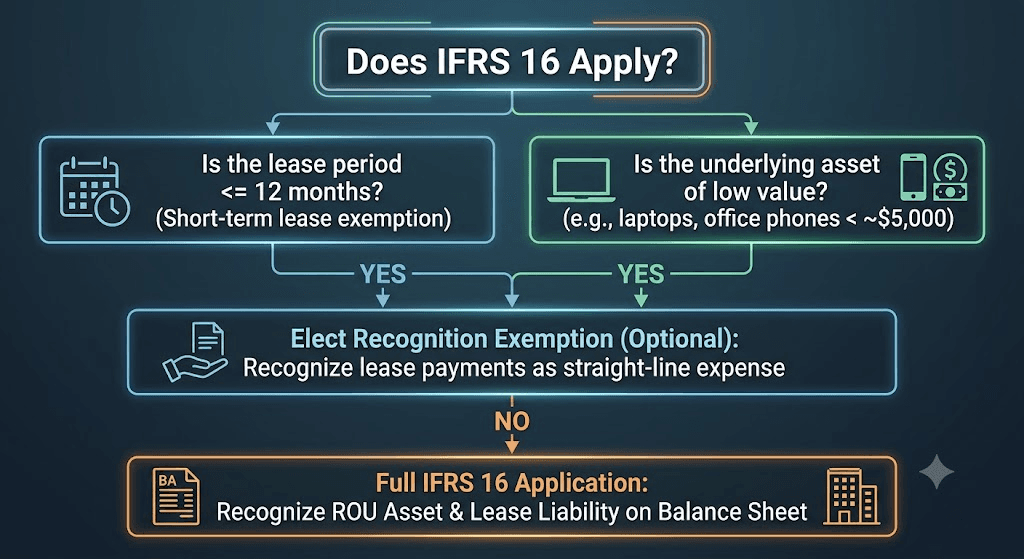
Does IFRS 16 Apply?
│
┌────────────────────────────┴────────────────────────────┐
▼ ▼
Is the lease period ≤ 12 months? Is the underlying asset of low value?
(Short-term lease exemption) (e.g., laptops, office phones < ~$5,000)
│ │
YES YES
│ │
└────────────────────────────┬────────────────────────────┘
▼
Elect Recognition Exemption (Optional):
Recognize lease payments as straight-line expense
│
NO
▼
Full IFRS 16 Application:
Recognize ROU Asset & Lease Liability on Balance Sheet
Optional Exemptions
Lessees can choose not to recognize ROU assets and lease liabilities for:
Short-term leases: Leases with a term of 12 months or less (containing no purchase options).
Leases of low-value assets: Leases where the underlying asset, when new, has a low value (typically under ~$5,000 USD, such as personal computers, office furniture, or telephones).
2. Initial Measurement Formulas
At the lease commencement date, the lessee measures both the Lease Liability and the ROU Asset.
Initial Measurement of Lease Liability
The initial lease liability is calculated as the present value (PV) of future lease payments discounted using the interest rate implicit in the lease. If that rate cannot be readily determined, the lessee uses its incremental borrowing rate (IBR).
InitialLeaseLiability=PVofFutureLeasePayments
Initial Measurement of ROU Asset
The initial cost of the ROU Asset is measured based on the initial liability amount plus several adjustments:
ROUAssetCost=InitialLeaseLiability+InitialDirectCosts+PrepaidLeasePayments-Lease Incentives Received+EstimatedRestorationCosts(IAS37)
3. Comprehensive Solved Example (Numerical + Journal Entries)
Let us examine a practical real-world scenario to demonstrate the accounting entries from commencement through Year 1.
Scenario Details
Commencement Date: 1 January 20X1
Lease Term: 3 years (non-cancellable)
Annual Payment: $10,000 payable annually in arrears on 31 December
Incremental Borrowing Rate (IBR): 6% per annum
Initial Direct Costs Incurred by Lessee: $1,500
Lease Incentive Received from Lessor on Day 1: $500
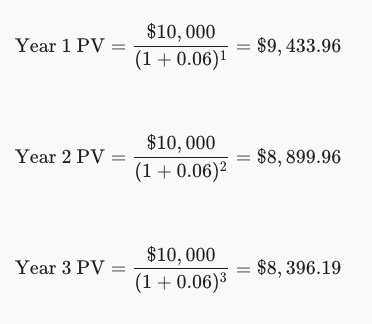
Step 1: Calculate the Present Value of Lease Payments
Using the 6% discount rate, calculate the present value of $10,000 payable annually at the end of Years 1, 2, and 3:
Step 2: Calculate the ROU Asset Initial Cost
Apply the ROU Asset valuation formula:
Element | Calculation Amount ($) |
Initial Lease Liability | $26,730.11 |
(+) Initial Direct Costs | +$1,500.00 |
(-) Lease Incentive Received | -$500.00 |
(=) Initial ROU Asset Cost | $27,730.11 |
Step 3: Build the Lease Amortization Schedule
Year | Opening Liability ($) | Interest Expense @ 6% ($) | Lease Payment ($) | Closing Liability ($) |
20X1 (Yr 1) | $26,730.11 | $1,603.81 | ($10,000.00) | $18,333.92 |
20X2 (Yr 2) | $18,333.92 | $1,100.04 | ($10,000.00) | $9,433.96 |
20X3 (Yr 3) | $9,433.96 | $566.04 | ($10,000.00) | $0.00 |
Note: Annual depreciation on the ROU Asset over the 3-year straight-line period = $27,730.11 / 3 years = $9,243.37 per year.
Step 4: Record Year 1 Journal Entries
Entry 1: Initial Recognition (1 January 20X1)
Date: 1 January 20X1
Account Titles & Explanation Debit ()Credit()
-----------------------------------------------------------------------
Dr. ROU Asset 27,730.11
Cr. Lease Liability 26,730.11
Cr. Cash / Bank (Net Direct Cost - Incentive) 1,000.00
(To record initial recognition of ROU Asset, Lease Liability, and net cash paid)
Entry 2: Year-End Payment & Interest Recognition (31 December 20X1)
Date: 31 December 20X1
Account Titles & Explanation Debit ()Credit()
-----------------------------------------------------------------------
Dr. Finance Expense / Interest (P&L) 1,603.81
Dr. Lease Liability 8,396.19
Cr. Cash / Bank 10,000.00
(To record annual lease payment splitting principal reduction and interest expense)
Entry 3: Annual ROU Asset Depreciation (31 December 20X1)
Date: 31 December 20X1
Account Titles & Explanation Debit ()Credit()
-----------------------------------------------------------------------
Dr. Depreciation Expense (P&L) 9,243.37
Cr. Accumulated Depreciation - ROU Asset 9,243.37
(To record straight-line annual depreciation on ROU Asset over 3-year term)
4. Balance Sheet & P&L Impact Comparison
The transition to IFRS 16 significantly alters key financial metrics compared to legacy operating lease treatment:
Financial Statement Impact
│
┌─────────────────────────┴─────────────────────────┐
▼ ▼
Balance Sheet Profit & Loss (P&L)
• Assets increase (ROU Asset) • Operating Lease Rent expense eliminated
• Liabilities increase (Current & Non-Current) • Front-loaded expense profile (Depreciation + Interest)
• Leverage ratios (Gearing/Debt-to-Equity) rise • EBITDA improves (Rent moved below EBITDA)
Financial Statement Presentation (At 31 December 20X1)
Statement of Profit or Loss (Year 1):
Operating Expenses (Depreciation Expense): $9,243.37
Finance Costs (Interest Expense): $1,603.81
Total P&L Expense Recognized: 10,847.18StatementofFinancialPosition(At31Dec20X1):Non-CurrentAssets:ROUAsset(27,730.11 - $9,243.37): $18,486.74
Current Liabilities:
Lease Liability (Due in 20X2): 8,899.96Non-CurrentLiabilities:LeaseLiability(18,333.92 - $8,899.96): $9,433.96
5. Common Accounting Pitfalls to Avoid
Confusing Current and Non-Current Lease Liabilities: At year-end, the closing lease liability must be split between the portion due within 12 months (current) and the remaining balance (non-current).
Ignoring Lease Modifications and Index Escalations: Variable lease payments tied to an index (like CPI) require remeasurement of the lease liability using an updated discount rate when cash flows change.
Miscalculating EBITDA Improvements: While EBITDA improves under IFRS 16 because rental costs are removed from operating expenses, total cash outflow remains unchanged.
Frequently Asked Questions (FAQs)
1. How is the ROU asset depreciated under IFRS 16?
The ROU asset is depreciated on a straight-line basis over the shorter of the lease term or the useful life of the underlying asset. However, if the lease transfers ownership to the lessee at the end of the term or if the lessee is reasonably certain to exercise a purchase option, the ROU asset is depreciated over the asset's full useful life.
2. What discount rate should be used if the implicit interest rate is unknown?
If the rate implicit in the lease cannot be readily determined, the lessee must use its Incremental Borrowing Rate (IBR)—the rate of interest that the lessee would have to pay to borrow over a similar term, and with a similar security, the funds necessary to obtain an asset of a similar value to the ROU asset in a similar economic environment.
3. How are short-term leases recorded under IFRS 16?
If a lessee elects the short-term lease exemption (lease term of 12 months or less with no purchase option), lease payments are recognized directly as an operating expense on a straight-line basis over the lease term, with no ROU asset or lease liability recognized on the balance sheet.
Master Financial Accounting & IFRS with Amit Dharaniya
Understanding technical IFRS accounting standards is critical for achieving top marks in professional exams and excelling in financial reporting careers. Whether you are preparing for ACCA, CA, or professional accounting assessments, getting expert direction makes all the difference.
Advance your accounting knowledge today:
Learn More About Amit Dharaniya: Explore insights, mentoring approaches, and professional advice at https://amitdharaniya.com/amitdharaniya.
Browse Expert Video Courses: Master complex accounting standards, practice calculations, and exam techniques with comprehensive structured modules at https://amitdharaniya.com/courses.
Key Takeaways
Measure ROU Assets by adjusting the initial lease liability for direct costs, prepayments, incentives, and restoration provisions.
Separate lease liabilities into current and non-current portions on the balance sheet.
Depreciate the ROU asset over the shorter of the lease term or the asset's useful life.
🚀 Ready to Start Your ACCA Journey?
Join Amit Dharaniya Global Academy today and get access to world-class mentorship, flexible learning, and guaranteed placement support.
Book Demo