IFRS 15 Revenue Recognition Simplified: The 5-Step Model for ACCA & CA Students
10/5/2026
Introduction
Revenue is the single most critical top-line metric on any entity’s Statement of Profit or Loss. For financial analysts, regulators, and investors, it serves as the baseline indicator of operational performance and corporate health. For candidates preparing for ACCA (Financial Reporting - FR, Strategic Business Reporting - SBR) and CA exams (ICAI, ICAEW, CPA), mastering revenue recognition accounting principles is essential for examination success.
Master IFRS & Financial Reporting with Expert Guidance
Looking to clear your ACCA or CA exams on the first attempt? Access high-impact technical articles, study guides, and resources by expert mentor Amit Dharaniya at amitdharaniya.com. To accelerate your exam prep with comprehensive, structured video lectures and practice kits, explore our full library of expert-led courses at amitdharaniya.com/courses.
IFRS 15 Revenue from Contracts with Customers was issued jointly by the International Accounting Standards Board (IASB) and the Financial Accounting Standards Board (FASB) to create a single, comprehensive, principles-based framework applicable across all global industries. It replaced the legacy standard IAS 18 Revenue, IAS 11 Construction Contracts, and related interpretations (IFRIC 13, IFRIC 15, IFRIC 18, and SIC-31).
The Core Paradigm Shift: From "Risks and Rewards" to "Control"
Under legacy accounting (IAS 18), revenue recognition hinged on whether an entity had transferred the significant risks and rewards of ownership to the buyer. This focus allowed room for subjective interpretation, aggressive revenue management, and inconsistent presentation across industries—particularly in complex bundled contracts (e.g., telecommunications, software licensing, and construction).
IFRS 15 fundamentally reshaped accounting practice by introducing a single core principle based on the transfer of control:
The Core Principle of IFRS 15:
An entity recognizes revenue to depict the transfer of promised goods or services to customers in an amount that reflects the consideration to which the entity expects to be entitled in exchange for those goods or services.
Control under IFRS 15 refers to the ability to direct the use of, and obtain substantially all of the remaining benefits from, an asset. It also includes the ability to prevent other entities from directing the use of and obtaining benefits from an asset.
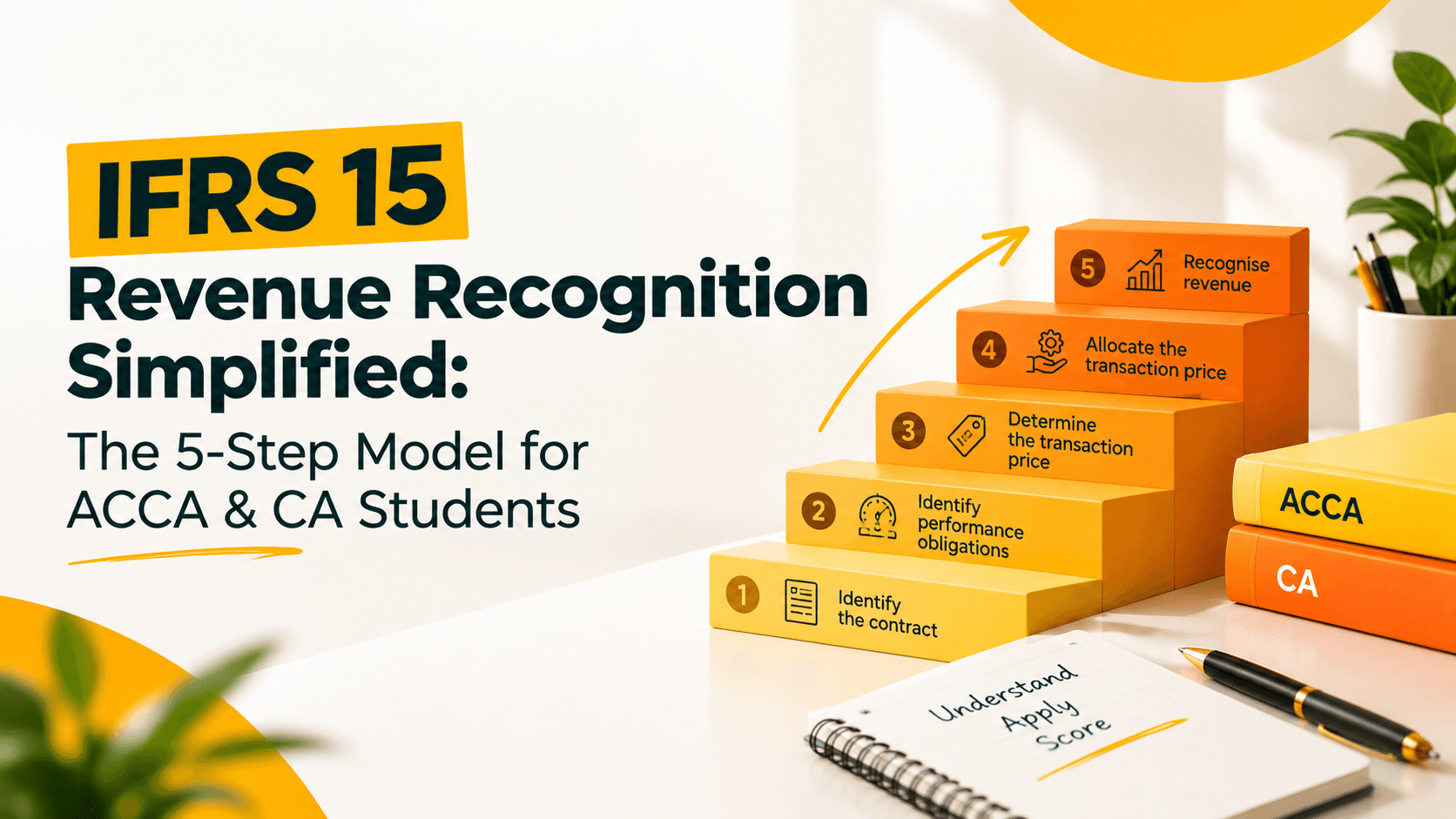
To apply this core principle consistently across simple sales and multi-million-dollar multi-element contracts, IFRS 15 establishes a mandatory 5-Step Model.
The 5-Step Model at a Glance
Step | Objective | Core Accounting Principle |
Step 1 | Identify the Contract | Establish whether a legally enforceable contract exists with a customer under the 5 mandatory criteria. |
Step 2 | Identify Performance Obligations | Unbundle the contract into distinct promises (goods or services) that must be accounted for separately. |
Step 3 | Determine Transaction Price | Calculate the total consideration expected, accounting for variable amounts, financing components, and non-cash elements. |
Step 4 | Allocate Transaction Price | Apportion the Step 3 transaction price to each Step 2 performance obligation using relative Standalone Selling Prices (SSP). |
Step 5 | Recognize Revenue | Recognize revenue when (or as) the entity satisfies each performance obligation by transferring control to the customer. |
Step 1: Identify the Contract with a Customer
A contract is an agreement between two or more parties that creates enforceable rights and obligations. Contracts can be written, oral, or implied by an entity’s customary business practices.
The 5 Mandatory Criteria
Under IFRS 15.9, an entity accounts for a contract with a customer only when all five of the following criteria are met:
Approval and Commitment: The parties have approved the contract (in writing, orally, or per customary business practices) and are committed to perform their respective obligations.
Identification of Rights: The entity can identify each party’s rights regarding the goods or services to be transferred.
Identification of Payment Terms: The entity can identify the payment terms for the goods or services to be transferred.
Commercial Substance: The contract has commercial substance—meaning the risk, timing, or amount of the entity's future cash flows is expected to change as a result of the contract.
Probable Collectability: It is probable (more likely than not, i.e., >50% likelihood) that the entity will collect the consideration to which it will be entitled. In evaluating collectability, the entity considers only the customer’s ability and intention to pay when due.
Exam Tip: If a contract does not meet all 5 criteria at inception, any non-refundable consideration received from the customer is recognized as a liability (contract liability / deferred income) until either all criteria are subsequently met or the contract is terminated and the consideration received is non-refundable (IFRS 15.15).
Contract Modifications
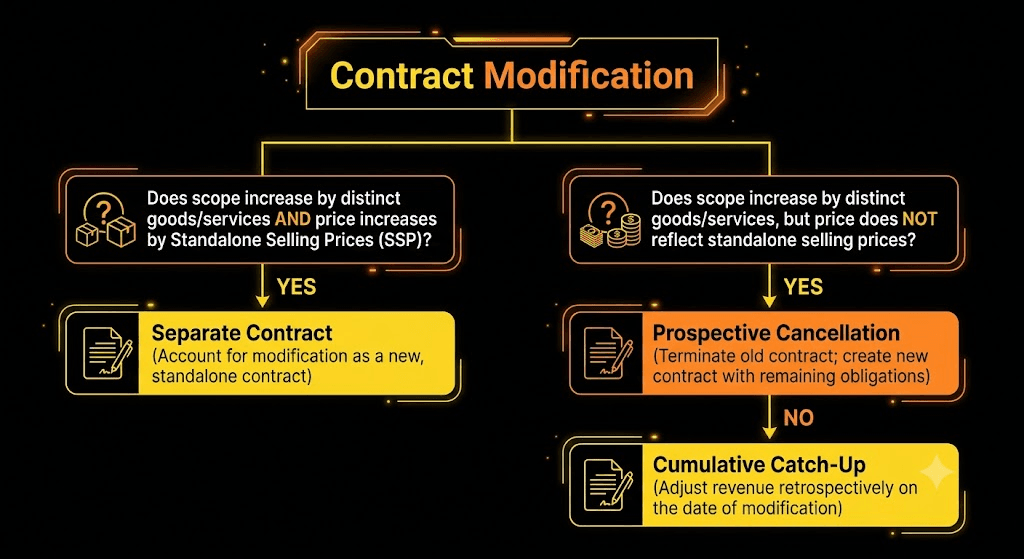
A contract modification is a change in the scope, price, or both of an existing contract that is approved by the parties. Under IFRS 15.20–21, an entity accounts for a modification in one of three ways:
Contract Modification
|
-------------------------------------------------
| |
Does scope increase by distinct Does scope increase by distinct
goods/services AND price increases goods/services, but price does NOT
by Standalone Selling Prices (SSP)? reflect standalone selling prices?
| |
YES YES
| |
[Separate Contract] [Prospective Cancellation]
(Account for modification (Terminate old contract; create new
as a new, standalone contract) contract with remaining obligations)
|
NO
|
[Cumulative Catch-Up]
(Adjust revenue retrospectively
on the date of modification)
Separate Contract (IFRS 15.20): Accounted for as a completely new, separate contract if:
The scope increases due to the addition of distinct promised goods or services; and
The contract price increases by an amount that reflects the entity's standalone selling prices (SSP) of those additional goods/services.
Prospective Termination and New Contract (IFRS 15.21(a)): Treated as the cancellation of the old contract and creation of a new contract if the remaining goods/services are distinct from those transferred on or before the modification date, but the price does not reflect their SSP. Unallocated consideration is allocated to remaining performance obligations.
Cumulative Catch-Up Adjustment (IFRS 15.21(b)): Treated as part of the original contract if the remaining goods or services are not distinct (e.g., a single partially completed construction contract). The entity updates the transaction price and measure of progress, recognizing a cumulative catch-up adjustment to revenue on the modification date.
Step 2: Identify Separate Performance Obligations
A performance obligation is a promise in a contract with a customer to transfer either:
A good or service (or a bundle of goods or services) that is distinct; or
A series of distinct goods or services that are substantially the same and have the same pattern of transfer.
The "Distinct" Test
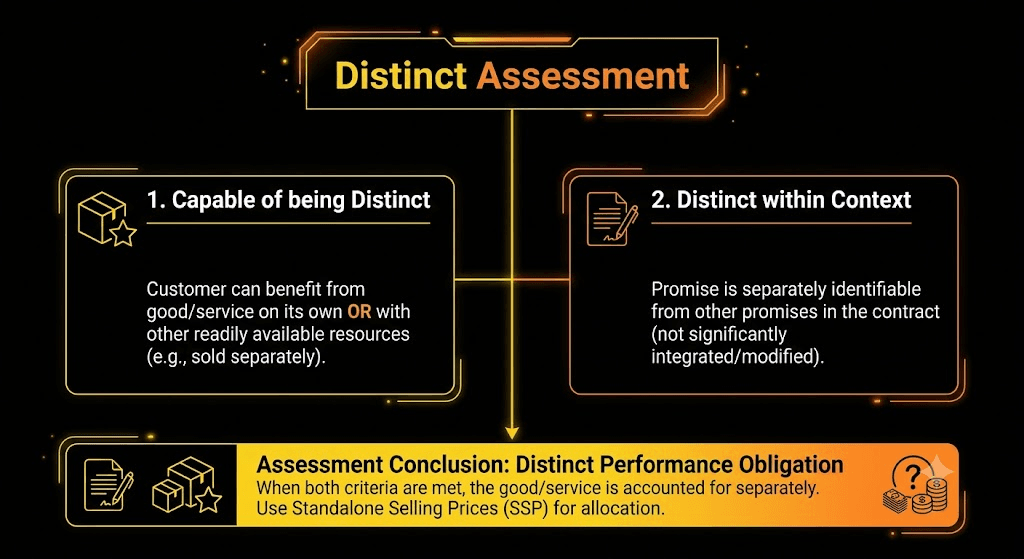
Under IFRS 15.27, a good or service promised to a customer is distinct if both of the following criteria are met:
Distinct Assessment
|
-------------------------------------------------------------------
| |
1. Capable of being Distinct 2. Distinct within Context
Customer can benefit from good/service Promise is separately identifiable
on its own OR with other readily available from other promises in the contract
resources (e.g., sold separately). (not significantly integrated/modified).
Criterion 1: Capable of being distinct
The customer can benefit from the good or service either on its own or together with other resources that are readily available to the customer (e.g., goods/services sold separately by the entity or competitors, or resources the customer has already acquired).
Criterion 2: Distinct within the context of the contract
The promise to transfer the good or service is separately identifiable from other promises in the contract. Indicators that a promise is not separately identifiable include:
Significant Integration: The entity provides a significant service of integrating the good or service with other goods or services into a combined output (e.g., building a complex custom house using bricks, timber, and steel).
Significant Modification/Customization: The good or service significantly modifies or customizes another good or service promised in the contract (e.g., custom software development integrated into legacy operating systems).
High Interdependence: The goods or services are highly interdependent or highly interrelated (e.g., designing and testing high-tech specialized equipment).
Unbundling vs. Combining Contracts
An entity must account for multi-element contracts (e.g., hardware + software license + 3 years of maintenance support) by unbundling distinct performance obligations.
Combined Contracts: Conversely, under IFRS 15.17, contracts entered into at or near the same time with the same customer (or related parties) must be combined and treated as a single contract if:
The contracts are negotiated as a package with a single commercial objective;
The consideration in one contract depends on the price or performance of the other; or
The goods/services promised constitute a single performance obligation.
Step 3: Determine the Transaction Price
The transaction price is the amount of consideration to which an entity expects to be entitled in exchange for transferring promised goods or services, excluding amounts collected on behalf of third parties (e.g., Value Added Tax or sales taxes).
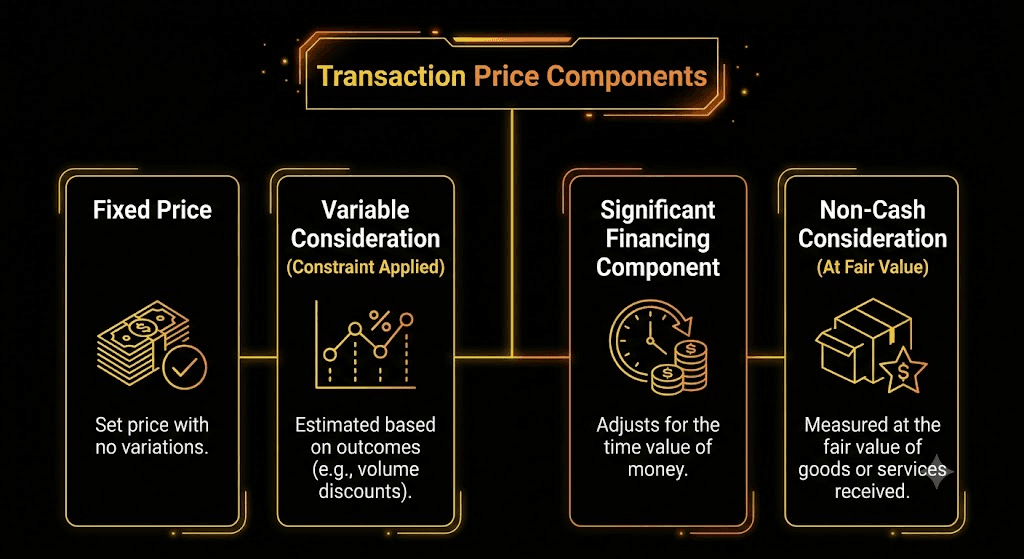
In determining the transaction price, the entity must account for the following four elements:
Transaction Price Components
|
---------------------------------------------------------------
| | | |
Fixed Variable Significant Non-Cash
Price Consideration Financing Consideration
(Constraint Applied) Component (At Fair Value)
1. Variable Consideration
If a contract includes variable amounts (e.g., discounts, rebates, refunds, credits, price concessions, performance bonuses, or penalties), the entity must estimate the total variable consideration using either:
Expected Value: The sum of probability-weighted amounts in a range of possible outcomes. Best suited for contracts with a large number of similar transactions (e.g., volume rebates).
Most Likely Amount: The single most likely outcome in a range of possible outcomes. Best suited for contracts with only two possible outcomes (e.g., a binary performance bonus for early completion).
The Variable Consideration Constraint (IFRS 15.56)
Variable consideration is included in the transaction price only to the extent that it is highly probable that a significant reversal in the cumulative amount of revenue recognized will not occur when the uncertainty associated with the variability is resolved.
2. Significant Financing Components
If the timing of payments provides the customer or the entity with a significant benefit of financing the transfer of goods or services, the transaction price must be adjusted for the time value of money.
Discounting Effect: If payment is deferred (customer financed), revenue is recognized at the present value of the cash flows using a discount rate that reflects customer credit risk, recognizing interest income over time.
Advance Payment: If the customer pays in advance, the entity recognizes interest expense over the period between payment and control transfer, increasing the contract liability and final revenue
Practical Expedient (IFRS 15.63): An entity does not need to adjust for a significant financing component if the period between transfer of control and payment is one year or less.
3. Non-Cash Consideration
Non-cash consideration (e.g., shares, property, plant, and equipment) is measured at fair value. If the entity cannot reasonably estimate the fair value of the non-cash consideration, it measures it indirectly by reference to the standalone selling price of the goods or services promised.
Step 4: Allocate the Transaction Price to Performance Obligations
The objective of Step 4 is to allocate the total transaction price (Step 3) to each separate performance obligation (Step 2) in an amount that depicts the consideration to which the entity expects to be entitled in exchange for satisfying each obligation.
Allocation Based on Relative Standalone Selling Prices (SSP)
Allocation must be executed on a relative Standalone Selling Price (SSP) basis determined at contract inception. Subsequent changes in SSP are not reallocated.
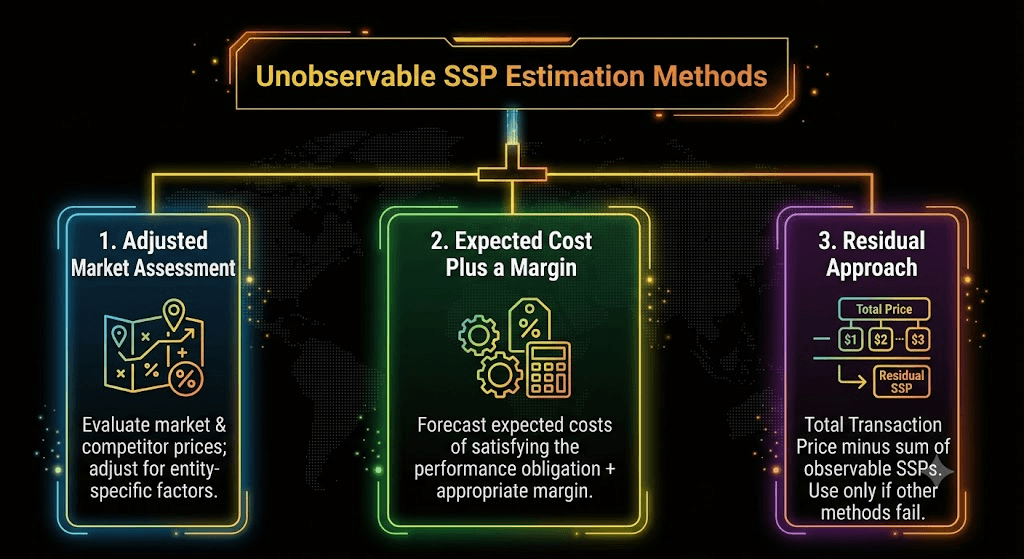
Unobservable SSP Estimation Methods
|
---------------------------------------------------------------
| | |
Adjusted Market Expected Cost Plus Residual
Assessment a Margin Approach
(Evaluate market & (Forecast costs + (Total Price minus
competitor prices) appropriate margin) observable SSPs)
When an SSP is not directly observable in an active market, the entity must estimate it using one of three approved methods (IFRS 15.79):
Adjusted Market Assessment Approach: Evaluate the market in which the entity sells goods/services and estimate the price that a customer in that market would be willing to pay.
Expected Cost Plus a Margin Approach: Forecast the expected costs of satisfying a performance obligation and add an appropriate profit margin.
Residual Approach: Deduct the sum of observable SSPs of other performance obligations from the total transaction price. This method is strictly restricted to situations where the selling price is highly variable or uncertain (e.g., brand-new software releases).
Allocating Discounts and Variable Consideration
Discounts: Discounts are allocated pro-rata to all performance obligations unless there is observable evidence that the discount relates specifically to one or two performance obligations (IFRS 15.82).
Variable Consideration: Variable consideration is allocated entirely to a specific performance obligation (or distinct good/service within a series) if the terms of the variable payment relate specifically to that obligation and the allocation reflects the entity’s expected entitlement.
Step 5: Recognize Revenue When (or As) Performance Obligations Are Satisfied
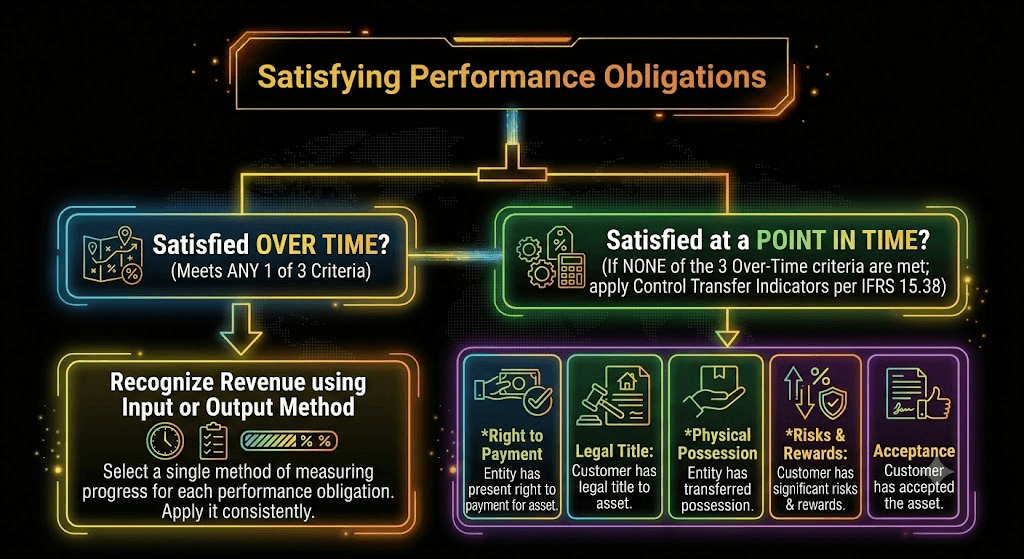
An entity recognizes revenue when (or as) it satisfies a performance obligation by transferring control of a promised good or service to a customer. Performance obligations are satisfied either Over Time or at a Point in Time.
1. Revenue Recognition "Over Time"
Under IFRS 15.35, an entity transfers control over time—and thus recognizes revenue over time—if any one of the following three criteria is met:
Condition | Criterion Description | Classic Real-World Example |
1. Simultaneous Consumption | The customer simultaneously receives and consumes the benefits provided by the entity's performance as the entity performs. | Routine cleaning services, payroll processing, or security monitoring services. |
2. Asset Creation/Enhancement | The entity's performance creates or enhances an asset (e.g., work in progress) that the customer controls as the asset is created or enhanced. | Building a factory on land owned by the customer; custom software developed directly on a client's server. |
3. No Alternative Use + Enforceable Right to Payment | The entity's performance does not create an asset with an alternative use to the entity, and the entity has an enforceable right to payment for performance completed to date. | Specialized military hardware constructed to unique specifications, or tailored consulting advisory reports. |
Measuring Progress Over Time
When revenue is recognized over time, progress must be measured using either:
Output Methods: Direct measurements of value transferred to date (e.g., surveys of performance completed, milestones reached, units produced/delivered).
Input Methods: Direct measurement of efforts/inputs expended relative to total expected inputs (e.g., costs incurred to date as a percentage of total estimated contract costs).
Exam Warning: Under input methods (cost-to-cost method), uninstalled materials held on-site by the customer must be excluded from progress calculations if the customer obtains control before installation and cost does not reflect the true level of progress (IFRS 15.B19).
2. Revenue Recognition at a "Point in Time"
If a performance obligation is not satisfied over time, it is satisfied at a point in time. Control transfer is evaluated using the indicators in IFRS 15.38:
Present Right to Payment: The entity has a present legal right to payment for the asset.
Legal Title: The customer has legal title to the asset.
Physical Possession: The entity has transferred physical possession of the asset.
Risks and Rewards: The customer has significant risks and rewards of ownership.
Customer Acceptance: The customer has accepted the asset.
Comprehensive Solved Master Example (Numerical + Journal Entries)
To consolidate these concepts, let us examine a multi-element telecommunications contract—a classic scenario tested heavily in ACCA FR/SBR and CA Financial Reporting exams.
The Scenario
Telco Comms Ltd enters into a 24-month telecom contract with a customer on 1 January 20X1.
Contract Terms:
The customer receives a high-end smartphone handset immediately on 1 January 20X1.
The customer subscribes to a 24-month network voice/data plan for ₹4,815 per month, payable at the end of each month.
The upfront cash paid by the customer on Day 1 for the handset is ₹ .
Standalone Selling Prices (SSP):
Handset sold on a standalone cash basis by Telco Comms Ltd: ₹57,780.
Network service plan sold on a standalone basis: ₹2,889 per month (Total 24-month value = ₹2,889 × 24 = ₹69,336).
Step-by-Step Accounting Treatment
Step 1: Identify the Contract
A valid contract exists under IFRS 15.9: legal enforceability exists, rights and monthly payment terms ($50/month) are identified, commercial substance is present, and collectability of monthly fees is probable.
Step 2: Identify Separate Performance Obligations
There are two distinct performance obligations:
Handset: Capable of being distinct and separately identifiable. Transferred at a point in time (1 January 20X1).
Network Services: A series of distinct daily services transferred over time (24 months).
Step 3: Determine the Transaction Price
Total consideration payable by customer over 24 months = 24 months × ₹4,815/month = ₹1,15,800.
(Assume no significant financing component for exam simplicity).
Step 4: Allocate Transaction Price based on Relative SSP
Let us calculate the relative allocation using a structured calculation table:
Performance Obligation | Standalone Selling Price (SSP) | % of Total SSP | Calculation Formula | Allocated Revenue |
Handset | ₹57,780 | 45.45% | (₹57,780 / ₹1,27,116) × ₹1,15,560 | ₹52,335 |
Network Services (24 Months) | ₹69,336 | 54.55% | (₹69,336 / ₹1,27,116) × ₹1,15,560 | ₹63,225 |
Total Contract Value | ₹1,27,116 | 100.00% | ₹1,15,560 |
Monthly Allocated Network Service Revenue = ₹63,225 / 24 months = ₹2,634.38 per month.
Step 5: Revenue Recognition & Journal Entries
Day 1: Transfer of Handset (1 January 20X1)
On Day 1, Telco Comms Ltd delivers the handset, satisfying its performance obligation at a point in time. Telco Comms Ltd recognizes ₹52,538 as Handset Revenue.
Because the customer pays $0 upfront and the right to payment is conditional on providing future network services over 24 months, the entity records a Contract Asset (not a trade receivable).
Date: 1 January 20X1
Account Titles & Explanation Debit ()Credit()
-----------------------------------------------------------------------
Dr. Contract Asset 545.45
Cr. Revenue (Handset Revenue - P&L) 545.45
(To recognize revenue on transfer of handset control on Day 1)
End of Month 1: Billing and Monthly Service Recognition (31 January 20X1)
At the end of Month 1, Telco Comms Ltd satisfies 1 month of network services, earning $27.27 in service revenue. Simultaneously, Telco Comms Ltd issues a bill for $50, creating an unconditional right to payment (Trade Receivable).
The ₹4,815 billed reduces the Contract Asset by its amortized portion (₹52,538 / 24 months = ₹2,189.08).
Unconditional Trade Receivable: ₹4,815.00
Network Service Revenue Recognized: ₹2,627.30
Reduction of Contract Asset: ₹2,187.70 (₹4,815.00 billed – ₹2,627.30 service
Date: 31 January 20X1
Account Titles & Explanation Debit ()Credit()
-----------------------------------------------------------------------
Dr. Trade Receivables 50.00
Cr. Revenue (Network Service - P&L) 27.27
Cr. Contract Asset 22.73
(To record monthly billing, recognize network service revenue, and amortize contract asset)
Collection of Cash for Month 1 (31 January 20X1 / Early February)
When the customer pays the monthly invoice:
Date: 31 January 20X1
Account Titles & Explanation Debit ()Credit()
-----------------------------------------------------------------------
Dr. Cash / Bank 50.00
Cr. Trade Receivables 50.00
(To record monthly cash collection from customer)
Summary Balance Sheet & P&L Position after Month 1
Statement of Profit or Loss (Month 1):
Handset Revenue: ₹52,538
Network Service Revenue: ₹2,627
Total Revenue Recognized: ₹55,165
Statement of Financial Position (At 31 January 20X1):
Contract Asset (₹52,538 − ₹2,189): ₹50,349
Trade Receivables (Post-Cash Collection): ₹0.00
Cash: ₹4,815
Over the 24-month contract life, the Contract Asset will be fully amortized to ₹0 (₹52,538 − [24 × ₹2,189] ≈ ₹0), and total recognized revenue will equal approximately ₹1,15,560 (₹52,538 handset + [24 × ₹2,627] network services).
Common ACCA & CA Exam Pitfalls to Avoid
Exam markers routinely highlight common errors made by professional accounting students. Keep these key distinctions in mind:
1. Contract Asset vs. Trade Receivable Distinction
Trade Receivable (IFRS 9): An unconditional right to consideration. Only the passage of time is required before payment of that consideration is due.
Contract Asset (IFRS 15): A conditional right to consideration in exchange for goods or services transferred to a customer. The right is conditioned on something other than the passage of time (e.g., the entity's future performance under the contract).
2. Recognizing Revenue on Cash Receipt
Revenue is recognized upon the transfer of control, not cash receipt. Receiving cash before control transfers creates a Contract Liability (deferred income). Transferring control before receiving cash (or an unconditional right to bill) creates a Contract Asset.
3. Ignoring the Variable Consideration Constraint
In questions involving performance bonuses, legal disputes, or sales with a right of return, students often recognize maximum potential revenue. Always evaluate whether it is highly probable that a significant revenue reversal will not occur. If not highly probable, constrain the variable revenue.
4. Incorrect Allocation of Standalone Selling Prices
When allocating transaction prices in Step 4, do not allocate prices based on cost alone. The mandatory baseline under IFRS 15 is relative Standalone Selling Price (SSP).
Frequently Asked Questions (FAQs)
1. What is the main difference between a Contract Asset and a Trade Receivable under IFRS 15?
A Trade Receivable represents an unconditional right to receive payment, meaning that only the passage of time is necessary before payment is due. A Contract Asset represents an entity’s right to consideration in exchange for goods or services transferred when that right is conditioned on future performance (e.g., completing additional milestones or providing ongoing service obligations under a bundled contract).
2. When should revenue be recognized over time versus at a point in time?
Revenue is recognized Over Time if the contract satisfies any one of three conditions under IFRS 15.35:
Customer simultaneously receives and consumes benefits as performed;
Performance creates or enhances an asset controlled by the customer; or
Performance creates a specialized asset with no alternative use to the entity, and the entity has an enforceable right to payment for work completed to date.
If none of these criteria are met, revenue must be recognized at a Point in Time when control transfers (indicated by legal title, physical possession, right to payment, and customer acceptance).
3. How do you handle variable consideration if the outcome is uncertain?
Variable consideration must be estimated using either the Expected Value method (for large volumes of similar contracts) or the Most Likely Amount method (for binary outcomes). However, the entity must apply the Variable Consideration Constraint: variable amounts are included in the transaction price only to the extent that it is highly probable that a significant reversal of cumulative revenue recognized will not occur when the uncertainty is resolved.
4. What is a standalone selling price and how do you estimate it if not directly observable?
The Standalone Selling Price (SSP) is the price at which an entity would sell a promised good or service separately to a customer in similar circumstances. If the SSP is not directly observable in an active market, an entity must estimate it using one of three standard techniques:
Adjusted Market Assessment Approach
Expected Cost Plus a Margin Approach
Residual Approach (restricted to highly variable or uncertain selling prices)
Upgrade Your Professional Accounting Journey
Mastering IFRS standard applications takes structured preparation and real-world accounting insights. Whether you are aiming for top marks in your ACCA or CA financial reporting papers or boosting your practical accounting skills:
Free Study Resources & Articles: Visit amitdharaniya.com for expert tips, standard breakdowns, and career guidance.
Premium Prep & Full Courses: Ready to take your skills to the next level? Explore the complete line-up of professional courses taught by Amit Dharaniya at amitdharaniya.com/courses.
Official Technical Resources & External Links
🚀 Ready to Start Your ACCA Journey?
Join Amit Dharaniya Global Academy today and get access to world-class mentorship, flexible learning, and guaranteed placement support.
Book Demo