How to Pass ACCA SBR First Attempt (2026 Strategy)
8/26/2026
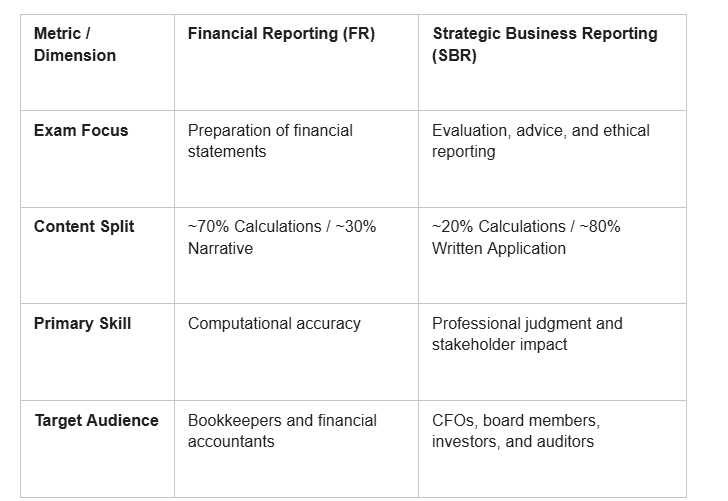
ACCA Strategic Business Reporting (SBR) maintains a global pass rate of 49–51%, and the primary reason half of candidates fail is treating SBR like Financial Reporting (FR). SBR is an advisory and analytical exam evaluating your ability to act as a senior financial consultant, not a mechanical calculation test.
The FR vs. SBR Mindset Pivot
Memory-based learning and formula memorization are the leading causes of SBR failure. In Financial Reporting (FR), performance relies heavily on preparing working papers and calculating precise numerical values. SBR flips this dynamic completely.

To pass SBR, you must transition from calculating numbers to explaining the financial narrative behind the numbers.
Decoding the 2026 Exam Structure & Professional Marks
The SBR exam lasts 3 hours and 15 minutes, administered on the ACCA Computer-Based Exam (CBE) platform. It totals 100 marks divided equally between two sections, including 25 technical marks per question plus 4 embedded Professional Skills marks.

SBR Exam Layout (100 Marks)
├── Section A (50 Marks)
│ ├── Question 1 (30 Marks): Group Financial Statements + Ethics (Includes 2 Professional Marks)
│ └── Question 2 (20 Marks): Accounting Standards + Ethical Scenario (Includes 2 Professional Marks)
└── Section B (50 Marks)
├── Question 3 (25 Marks): Applied Scenario / Standard Interpretation (Includes 2 Professional Marks)
└── Question 4 (25 Marks): Stakeholder Analysis / Current Developments (Includes 2 Professional Marks)
Earning the 4 Professional Skills Marks
Professional marks are not awarded for raw technical knowledge. They are earned by demonstrating four specific behavioral competencies:
Communication: Structuring your answer logically with subheadings, clear paragraphs, and a professional tone suitable for the specified stakeholder (e.g., briefing note to the CFO).
Commercial Acumen: Recommending practical solutions that account for real-world business realities, market conditions, and operational constraints.
Analysis & Critical Evaluation: Scrutinizing management’s assumptions, evaluating alternative accounting treatments, and assessing impact on financial statements.
Professional Skepticism: Questioning management bias, identifying aggressive revenue recognition, and challenging unethical financial manipulation.
High-Yield IFRS & IAS Priority List
While the SBR syllabus is vast, certain standards carry heavy weight across every exam sitting. Prioritise these core standards during revision:
IFRS 10 & IAS 28 (Group Financial Statements): Step acquisitions, partial disposals, loss of control, foreign subsidiaries, and accounting for associates/joint ventures.
IFRS 9 (Financial Instruments): Classification (Amortized Cost, FVOCI, FVTPL), business model tests, Expected Credit Loss (ECL) impairment models, and hedge accounting criteria.
IFRS 15 (Revenue from Contracts with Customers): Applying the 5-step model to complex arrangements (variable consideration, performance obligations satisfied over time, principal vs. agent considerations).
IFRS 16 (Leases): Lessee accounting, lease modifications, and sale-and-leaseback transactions under varying economic terms.
IAS 12 (Income Taxes): Calculation of temporary differences, deferred tax assets on unused losses, and deferred tax consequences of business combinations.
IAS 36 & IAS 38 (Impairment & Intangibles): Allocating impairment to Cash-Generating Units (CGUs), testing goodwill, capitalization of development costs, and revaluation models.
Ethics & The Conceptual Framework: Fundamental ethical principles (integrity, objectivity, professional competence) combined with the qualitative characteristics of useful financial information.
The 4-Step Answer Framework (Scenario Application Model)
To secure maximum technical and professional marks, apply this repeatable 4-step narrative structure to every scenario-based question:
State the Standard Rule: Write 1–2 concise sentences summarizing the core accounting principle without copying verbatim from the syllabus.
Apply to Scenario Facts: Explicitly link the rule to the specific events, numbers, or management actions described in the case study.
Explain Financial Impact: Clearly outline the accounting treatment across the Statement of Profit or Loss (P&L), Statement of Financial Position (SoFP), and key financial ratios.
Provide Stakeholder Advice: State how investors, lenders, or auditors will interpret this reporting and provide a clear professional recommendation.
Specific Advice for Indian Commerce & CA Students
Indian students transitioning from ICAI CA, B.Com, or Ind AS environments frequently face specific challenges on ACCA’s CBE platform:
Avoid Verbatim Reproduction: Indian academic formats often reward memorizing entire provisions. ACCA examiners actively penalize rote-memorized blocks of text that do not directly address scenario facts.
Optimize Typing & CBE Formatting: Ensure a typing speed of at least 35–40 words per minute. Use clear spacing, bold subheadings, and short paragraphs (2–4 sentences) rather than dense walls of text.
Do Not Copy-Paste Scenario Text: Copying long snippets from the question stem into your answer response yields zero marks and consumes critical exam time.
Ind AS vs. IFRS Nuances: While Ind AS is substantially converged with IFRS, ensure you use international terminology (e.g., Statement of Financial Position instead of Balance Sheet, Profit or Loss instead of P&L Account).
90-Day Week-by-Week Action Plan

Allocating approximately 180 total study hours over 12 weeks ensures thorough coverage and exam readiness.
Weeks 1–4: Conceptual Mastery ➔ Weeks 5–8: Topic Question Practice ➔ Weeks 9–12: CBE Mocks & Exam Polish
Weeks 1–4 (Conceptual Mastery): Study 2 hours daily. Work through the technical syllabus, construct 1-page summary sheets for key IFRS standards, and understand fundamental ethical frameworks.
Weeks 5–8 (Topic-Wise Past Paper Practice): Solve past exam questions topic by topic. Practice writing complete narrative answers rather than just reading answer keys.
Weeks 9–12 (CBE Platform Mocks & Examiner Reports): Attempt at least 3 full-length timed mock exams directly on the official ACCA Practice Platform. Review official ACCA Examiner Reports to identify common student mistakes and refine your time management strategy (1.95 minutes per mark).
High-Authority Strategic References
Refer to official resources to align your preparation with current examination standards:
Official ACCA Global SBR Resources: Access syllabus guides, specimen exams, and technical articles at ACCA Global.
Official ACCA Examiner Reports: Review historical feedback on student performance at ACCA Student Study Resources.
International Accounting Standards Board: Review standard updates directly at the IFRS Foundation.
Frequently Asked Questions (FAQs)
Q1: Is ACCA SBR harder than Financial Reporting (FR)?
Yes, SBR is conceptually more demanding than FR because it tests advanced evaluation, professional judgment, and written communication rather than routine computational steps. While FR focuses on statement preparation, SBR focuses on advising stakeholders on complex financial reporting issues.
Q2: How many hours should I study to pass SBR on the first attempt?
Candidates should aim for approximately 150 to 180 hours of total study time spread over 8 to 12 weeks. This time should be split equally between conceptual learning and practicing past exam questions on the official CBE platform.
Q3: How are professional skills marks awarded in ACCA SBR?
The 4 professional skills marks are embedded within the questions and evaluated across four criteria: Communication, Commercial Acumen, Analysis & Critical Evaluation, and Professional Skepticism. You earn them organically by structuring your response professionally, questioning management's assumptions, and offering sound business advice.
Q4: What happens if I make a calculation mistake in SBR Section A group accounting?
ACCA employs the "Own Figure Rule" (OFR). If you make an arithmetic or technical error early in a multi-step calculation, you will only lose the mark for that specific error. Subsequent calculations that correctly utilize your incorrect figure will still receive full credit.
Q5: Can I pass ACCA SBR by self-study, or do I need formal coaching in India?
While self-study is possible for disciplined candidates, enrolling with an approved learning partner like Amit Dharaniya Global Academy (ADGA) significantly increases first-time pass rates. Personalized coaching provides expert answer evaluation, feedback on professional mark allocation, and structured mock exam reviews on the CBE platform.
Master ACCA SBR with Amit Dharaniya Global Academy
Conquer Strategic Business Reporting with expert guidance from Amit Dharaniya Global Academy (ADGA). Our programs deliver:
Direct Founder Mentorship: Learn key IFRS application techniques directly from expert faculty.
Daily Live Doubt Resolution: Clear technical queries immediately to keep your revision schedule on track.
CBE Mock Evaluations: Receive detailed feedback on your typing structure, professional marks, and time allocation.
Ready to clear SBR on your first attempt? Contact ADGA Today to speak with a senior ACCA mentor and claim your custom study plan.
🚀 Ready to Start Your ACCA Journey?
Join Amit Dharaniya Global Academy today and get access to world-class mentorship, flexible learning, and guaranteed placement support.
Book Demo