CA Foundation vs ACCA After Class 12: What Should You Choose?
3/6/2026
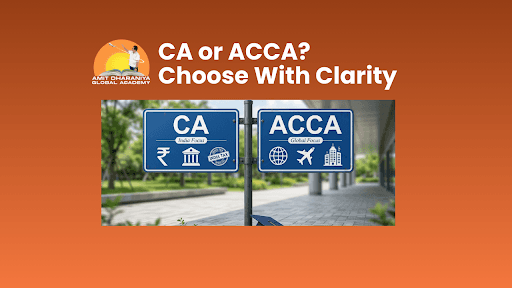
Right after Class 12, most commerce students and parents want the same thing. A qualification that has respect, stable outcomes, and a career path that does not feel like guesswork. That is exactly why this comparison keeps coming up in Indian homes, coaching centres, and school counselling rooms.
If you have typed CA vs ACCA, which is better into Google, you are not alone. The confusion is valid because both paths lead to strong finance careers, but they are built for different career geographies, different learning styles, and different definitions of flexibility. The best choice is not the one your friend is choosing. It is the one that matches your child’s temperament and the kind of career they actually want five years from now.
This guide is written to help parents make a safer decision, without marketing noise. It will also help students explain their preference clearly at home, because a good career choice becomes much easier when parents and students are aligned.
If you are still unsure by the end, book a counselling call and discuss your child’s profile, not just the course brochure.
Understanding The Two Routes After Class 12
Let us start with what each course really is, because parents often compare them as if they were the same product with different labels. They are not.
CA is India’s chartered accountancy qualification regulated by ICAI. It is deeply rooted in Indian taxation, Indian corporate law, and statutory compliance. It is highly respected in India, and it has a strong place in traditional practice and corporate finance. One key legal advantage is that under Indian company law, a person is eligible to be appointed as a company auditor only if they are a chartered accountant in practice. This is one reason CA remains a powerful choice for students who see their future primarily in India.
ACCA is a global qualification with a much wider international footprint. ACCA describes itself as a global community of 257,900 members and 530,100 future members across 180 countries. It is designed with international employer expectations in mind, and it places heavy emphasis on professional ethics, global reporting, and business decision-making.
Now the real question becomes clearer. When families ask CA vs ACCA which is better, they are actually asking, “Do we want India first depth or global first mobility?”
What Does CA Foundation After Class 12 Actually Involve?
If your child is thinking of CA Foundation after 12, it helps to understand what the next few years typically look like. The pathway includes Foundation, Intermediate, and Final, and it also includes a mandatory practical training period called articleship. The course is rigorous, and it is meant to build strong technical capability in auditing, taxation, and compliance, especially in an Indian context.
Parents should also understand that CA exams are competitive and that pass rates can be low, especially when students do not have a disciplined routine. For example, ICAI’s official result analysis for the September 2025 CA Foundation exam shows a total pass percentage of 14.78%. This does not mean CA is “too hard.” It means it demands consistency, revision discipline, and emotional stamina over a long period.
For the right student, CA can be an excellent fit. That student usually has patience, can handle long study cycles, and is comfortable with detailed law-based learning. Parents who want a career anchored in India, including audit and tax roles, often feel more comfortable with CA because it is the most established path in the Indian market.
Can ACCA be done after 12th?
Yes, it can, and this is one of the reasons ACCA is increasingly considered by Indian families who want a global option without waiting for graduation.
ACCA’s published minimum entrance requirements include an India-specific reference for senior secondary qualifications. For India, ACCA lists the senior school certificate or senior secondary school examination as sufficient for registration, provided passes are held in five subjects, including English and Mathematics or Accounts, with a mark of 65% in at least two subjects and over 50% on the others. That is a helpful clarity point for parents, because it makes eligibility feel less mysterious.
The bigger structural difference is this. ACCA is built as a modular journey where students can progress step by step, with exam sessions spread across the year. Along the way, students also complete an Ethics and Professional Skills module, which ACCA positions as a key part of the journey to membership. And to become an ACCA member, students must complete a minimum of 36 months of relevant work experience and achieve performance objectives as part of the Practical Experience Requirement.
In simple parent language, ACCA is not just exams. It is a professional formation journey that blends study with workplace readiness.
How Is ACCA Different From CA In Real Life?
Many parents search for the phrase How is ACCA different from CA because they want differences that matter on the ground, not just syllabus charts. Here are the differences that usually protect a decision.
The first difference is career geography. CA is strongest in India, especially for roles tied to Indian regulation and statutory work. ACCA is structured for global mobility, and its community and recognition are built across 180 countries. If your child dreams of working abroad or with global finance teams inside India, this matters.
The second difference is learning style and flexibility. CA is intense, and it often requires long, uninterrupted study phases, especially around group exams. ACCA is modular and can be planned alongside college more predictably, especially when coaching is disciplined. This does not mean ACCA is easy. It means the structure can feel more manageable for students who do better with short targets and frequent checkpoints.
The third difference is the type of work experience. CA includes a structured articleship model as a central pillar. ACCA requires 36 months of relevant experience and defined performance objectives for membership, and students can plan this experience in a way that fits their career route.
The fourth difference is where students often get stuck. In both courses, students struggle when they rely on motivation instead of routine. That is why the quality of coaching and mentorship is not a small factor. It is often the deciding factor.
This is also where the question of CA vs ACCA, which is better, becomes more personal than academic. The “better” path is the one your child will actually finish.
A Parent-Friendly Way To Choose Without Regret
If your child wants to build a long-term career in India with deep expertise in Indian tax, audit, and compliance, CA is often a strong match. It is a respected path, and it builds credibility in traditional finance roles. It is especially attractive when the student is mentally ready for a longer journey and can handle high-pressure exam phases without losing confidence.
If your child wants a qualification built for global recognition, with international standards and a pathway that can be planned around college, ACCA can be a strong match. It is also a practical choice when parents want a structured route that builds employability skills early, not only after the final exam.
If you are still asking CA vs ACCA which is better, ask one more question at home. “Where do you see yourself working and what kind of work do you want to do daily?” That answer usually brings more clarity than any comparison chart.
A good decision becomes easier when it is explained properly. Ask your child to share their five-year career picture, and then choose the course that supports it.
Whatever You Choose, ADGA Will Help Support Your Child
Many institutes teach ACCA paper-wise, but ADGA’s model is built around discipline and mentorship as a system. ADGA follows a batch-based learning model with one paper every three months, with structured timetables and focused mentoring, and it does not allow mid-batch admissions from other institutes to protect learning quality.
This is helpful for students who are capable but easily distracted, and for parents who want predictability. ADGA offers classroom-based, live online, live recorded, and pre-recorded training, and it operates through centres in Chandigarh and Dehradun.
So if you are specifically considering ACCA coaching in Chandigarh or ACCA coaching in Dehradun, you are not limited to one learning mode or one type of schedule. The centre choice can match the student’s routine without losing structure.
If you want a structured recommendation based on your child’s profile, speak to the ADGA team. The goal is not to push ACCA. The goal is to help you choose correctly and then stay consistent.
🚀 Ready to Start Your ACCA Journey?
Join Amit Dharaniya Global Academy today and get access to world-class mentorship, flexible learning, and guaranteed placement support.
Book Demo