Big 4 Technical Interview Questions for ACCA & Finance Graduates (2026 Model Answers)
10/22/2026

Standing across the desk—or on a video screen—from a Senior Partner or Managing Director at Deloitte, PwC, EY, or KPMG is fundamentally different from sitting a university exam or completing an ACCA/CA paper.
In a Big 4 technical interview, the interviewer is not testing whether you can recite the exact wording of IAS 16 / Ind AS 16 or SA 315. They are testing your ability to think like a Senior Manager: can you dissect a chaotic business scenario, apply the governing accounting framework, quantify the financial statement impact in ₹, and communicate your rationale concisely to a CFO?
Whether you are applying for roles in Audit & Assurance, Tax & Regulatory Services, Deals & Corporate Finance Advisory, or Financial Accounting Advisory Services (FAAS), this guide provides model answers to the most frequently asked Big 4 technical questions in 2026.
What Big 4 Technical Interviewers Look For in 2026
When Big 4 interview panels evaluate candidates, they score answers across four distinct pillars:
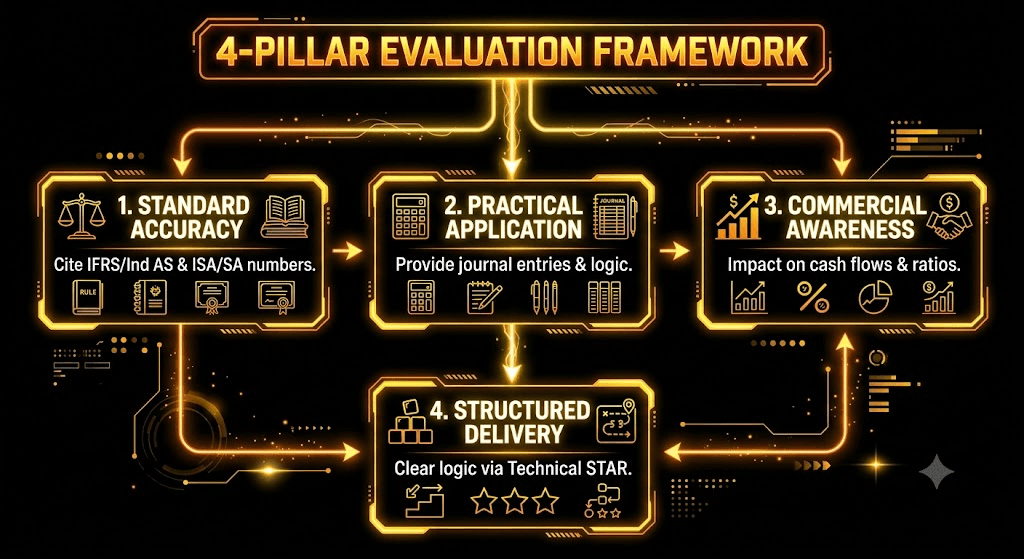
4-Pillar Evaluation Framework
│
┌────────────────────────────────┼────────────────────────────────┐
▼ ▼ ▼
┌─────────────────┐ ┌─────────────────┐ ┌─────────────────┐
│ 1. Standard │ │ 2. Practical │ │ 3. Commercial │
│ Accuracy │ │ Application │ │ Awareness │
│ Cite IFRS/Ind AS│ │ Provide journal │ │ Impact on cash │
│ & ISA/SA numbers│ │ entries & logic │ │ flows & ratios │
└─────────────────┘ └─────────────────┘ └─────────────────┘
│
▼
┌─────────────────┐
│ 4. Structured │
│ Delivery │
│ Clear logic via │
│ Technical STAR │
└─────────────────┘
Technical Standard Accuracy: Direct citation of relevant IFRS, Ind AS, or International Standards on Auditing (ISA/SA).
Practical Case Application: The ability to trace transactions down to T-accounts, debit/credit journal entries, and financial statement lines.
Commercial Awareness: Understanding how accounting treatments affect key metrics like EBITDA, net working capital, bank covenants, and tax exposure.
Communication Clarity: Presenting complex accounting treatments in structured, logical, and unambiguous terms.
Category 1: Financial Reporting & IFRS / Ind AS Questions
Question 1: Walk me through a complex multi-element revenue contract under IFRS 15 / Ind AS 115.
Model Answer:
"Under IFRS 15 / Ind AS 115 Revenue from Contracts with Customers, multi-element contracts are evaluated using the mandatory 5-Step Model. Let’s take a classic telecommunications scenario: a customer signs a 24-month contract receiving a high-end smartphone on Day 1 for ₹0 upfront and pays ₹4,000 per month for monthly voice/data services. Standalone selling prices (SSP) are ₹48,000 for the handset and ₹2,400 per month (₹57,600 total) for the service.
Here is the exact step-by-step accounting application:
Step 1 (Identify Contract): Enforceable 24-month agreement with distinct payment terms.
Step 2 (Identify Performance Obligations): Two distinct performance obligations—the handset (transferred at a point in time) and the monthly network service (transferred over time).
Step 3 (Determine Transaction Price): Total contract consideration = 24 months × ₹4,000 = ₹96,000.
Step 4 (Allocate Transaction Price based on Relative SSP):
Total SSP = ₹48,000 (Handset) + ₹57,600 (Network Service) = ₹1,05,600.
Handset Allocation = (₹48,000/₹1,05,600)₹96,000=₹43,636.36.
Service Allocation = (₹57,600/₹1,05,600)₹96,000=₹52,363.64 (₹2,181.82permonth).
Step 5 (Recognize Revenue):
Day 1 (Handset Delivery): Record ₹43,636.36 in revenue. Because the right to payment is conditional on providing future network services, record a Contract Asset rather than a trade receivable.
Date: Day 1 (Handset Transfer)
Account Titles Debit (₹) Credit (₹)
-------------------------------------------------------------------
Dr. Contract Asset 43,636.36
Cr. Revenue (Handset - P&L) 43,636.36
End of Month 1 (Billing): Bill ₹4,000 to the customer. Recognize ₹2,181.82 in monthly service revenue, with the balance reducing the Contract Asset.
Date: Month 1 End
Account Titles Debit (₹) Credit (₹)
-------------------------------------------------------------------
Dr. Trade Receivables 4,000.00
Cr. Revenue (Network Service - P&L) 2,181.82
Cr. Contract Asset 1,818.18
Over 24 months, the Contract Asset amortizes to zero, and total revenue recognized equals the ₹96,000 cash collected."
Question 2: How do you calculate ROU Assets and Lease Liabilities under
IFRS 16 / Ind AS 116? Include initial direct costs and lease incentives.
Model Answer:
"Under IFRS 16 / Ind AS 116, lessees must bring almost all operating leases onto the balance sheet by recognizing a Right-of-Use (ROU) Asset and a corresponding Lease Liability.
1. Lease Liability Calculation
The Lease Liability is the present value of future lease payments discounted at the interest rate implicit in the lease or the lessee’s Incremental Borrowing Rate (IBR):
LeaseLiability=PVofFutureLeasePayments
2. ROU Asset Calculation Formula
ROUAsset=InitialLeaseLiability+InitialDirectCosts+PrepaidLeasePayments-LeaseIncentivesReceived+RestorationProvisions(IAS37/IndAS37)
Numerical Example:
A company enters a 3-year lease paying ₹8,00,000 annually in arrears. IBR = 6%. Initial direct costs = ₹1,20,000; lease incentive received on Day 1 = ₹40,000.
Present Value of Lease Payments (6% over 3 years): ₹8,00,0002.6730=₹21,38,400.
ROU Asset Initial Cost: ₹21,38,400+₹1,20,000-₹40,000=₹22,18,400.
Initial Recognition Journal Entry:
Date: Commencement Date
Account Titles Debit (₹) Credit (₹)
-------------------------------------------------------------------
Dr. ROU Asset 22,18,400
Cr. Lease Liability 21,38,400
Cr. Cash / Bank (Net Direct Cost - Incentive) 80,000
Subsequently, the Lease Liability accrues interest expense using the effective interest method while being reduced by annual cash payments. The ROU Asset is depreciated on a straight-line basis over the shorter of the lease term or the underlying asset's useful life."
Question 3: What is the difference between a Deferred Tax Asset (DTA) and
Deferred Tax Liability (DTL)? Give a numerical example involving accelerated depreciation.
Model Answer:
"Deferred tax arises under IAS 12 / Ind AS 12 Income Taxes due to temporary differences between the carrying amount of an asset or liability on the Balance Sheet and its tax base (value for tax authorities).
Deferred Tax Liability (DTL): Arises when carrying amount of an asset > tax base. Represents future taxable amounts (tax is paid later).
Deferred Tax Asset (DTA): Arises when carrying amount of an asset < tax base. Represents future tax-deductible amounts (tax paid upfront).
Numerical Example (Accelerated Tax Depreciation):
An entity buys machinery for ₹80,00,000.
Accounting Treatment: Straight-line depreciation over 4 years (₹20,00,000/year).
Tax Treatment: Accelerated tax depreciation of 40% in Year 1 (₹32,00,000).
Tax Rate: 25%.
Year 1 End Metrics | Accounting Books | Tax Authority Books | Temporary Difference |
Asset Carrying Value | ₹60,00,000 (₹80L - ₹20L) | ₹48,00,000 (₹80L - ₹32L) | ₹12,00,000 (Taxable) |
Because the carrying amount (₹60,00,000) exceeds the tax base (₹48,00,000) by ₹12,00,000, a Deferred Tax Liability (DTL) is recognized:
{DTL} ={Temporary Difference}x {Tax Rate} ={₹}12,00,000 x 25% = \mathbf{{₹}3,00,000}
Date: Year 1 End
Account Titles Debit (₹) Credit (₹)
-------------------------------------------------------------------
Dr. Deferred Tax Expense (P&L) 3,00,000
Cr. Deferred Tax Liability (Balance Sheet) 3,00,000
This DTL will reverse over Years 2–4 as accounting depreciation exceeds tax depreciation."
Question 4: How do you test for Goodwill Impairment under IAS 36 / Ind AS 36?
Model Answer:
"Under IAS 36 / Ind AS 36 Impairment of Assets, goodwill acquired in a business combination is not amortized. Instead, it must be tested for impairment annually (or more frequently if an impairment indicator exists) at the Cash-Generating Unit (CGU) level.
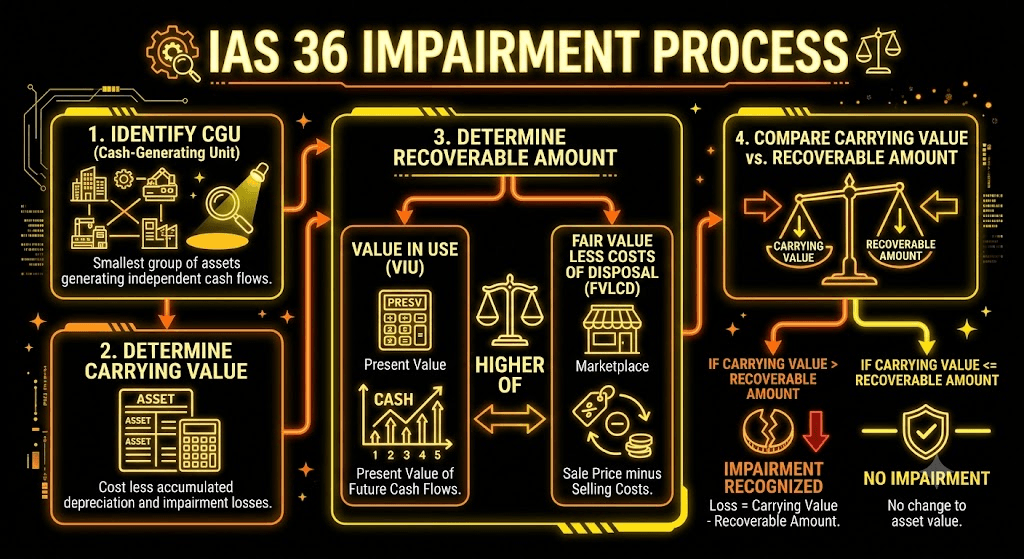
The 4-Step Impairment Process:
IAS 36 Impairment Process
│
1. Identify CGU ────────► 2. Determine Carrying Value ────────► 3. Determine Recoverable Amount
│
Higher of: Value in Use (VIU)
OR Fair Value Less Costs of
Disposal (FVLCD)
│
▼
4. Compare Carrying Value
vs. Recoverable Amount
Identify the CGU: The smallest identifiable group of assets that generates cash inflows largely independent of other assets.
Determine Carrying Value of CGU: Total carrying amount of CGU assets, including allocated goodwill.
Determine Recoverable Amount: The higher of:
Fair Value Less Costs of Disposal (FVLCD); and
Value in Use (VIU): Present value of estimated future cash flows derived from the CGU using a pre-tax discount rate (WACC).
Recognize Impairment Loss: If Carrying Value > Recoverable Amount
ImpairmentLoss=CarryingValue-RecoverableAmount
Allocation Order of Impairment Loss:
First, reduce allocated goodwill to zero.
Second, allocate remaining loss pro-rata across other non-current assets in the CGU based on relative carrying values (subject to not reducing any asset below its individual recoverable amount).
Crucial Note: Goodwill impairment losses recognized in Profit or Loss can never be reversed in subsequent periods under IAS 36 / Ind AS 36."
Category 2: Audit & Assurance Technical Questions
Question 1: Walk me through the Audit Risk Model and how you adjust substantive testing when Control Risk is high.
Model Answer:
"The Audit Risk Model under ISA 200 / SA 200 governs overall audit planning:
AuditRisk(AR)=InherentRisk(IR)ControlRisk(CR)DetectionRisk(DR)
Inherent Risk (IR): Susceptibility of an assertion to misstatement before considering internal controls (e.g., complex valuation of financial derivatives).
Control Risk (CR): Risk that client internal controls fail to prevent or detect material misstatements.
Risk of Material Misstatement (RMM): Combined assessment of IRCR.
Detection Risk (DR): Risk that auditor substantive procedures fail to detect misstatements.
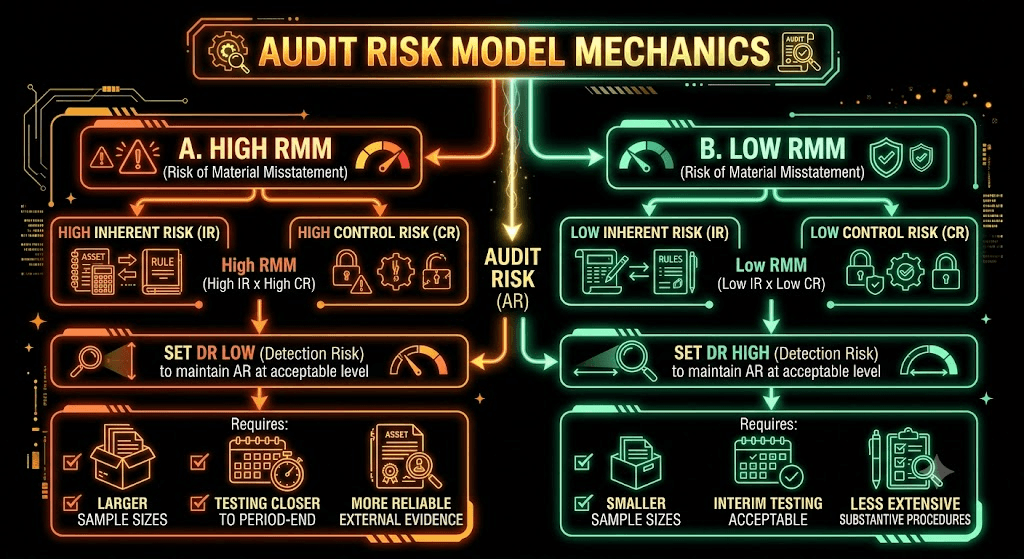
Audit Risk Model Mechanics
│
┌───────────────────────────────┴───────────────────────────────┐
▼ ▼
High RMM (High IR x High CR) Low RMM (Low IR x Low CR)
│ │
▼ ▼
Set DR LOW to maintain AR at acceptable level Set DR HIGH to maintain AR at acceptable level
│ │
▼ ▼
Requires: Requires:
• Larger sample sizes • Smaller sample sizes
• Testing closer to period-end • Interim testing acceptable
• More reliable external evidence • Less extensive substantive procedures
Adjusting Substantive Procedures when Control Risk is High:
If CR is evaluated as high (e.g., weak internal controls or failed control testing), the auditor must set Detection Risk to LOW to maintain overall Audit Risk at an acceptably low level.
Audit Modifications:
Nature: Shift from analytical procedures to detailed testing of transactions and external third-party confirmations (e.g., bank confirmations, receivables balance confirmations).
Timing: Perform substantive procedures at or after year-end rather than at interim dates.
Extent: Increase audit sample sizes significantly across high-risk assertions."
Question 2: How would you test for Unrecorded Liabilities (Cut-off assertion) during a year-end audit?
Model Answer:
"Testing for unrecorded liabilities—often referred to as the Search for Unrecorded Liabilities (SURL)—primarily targets the Completeness and Cut-off assertions for accounts payable and accrued expenses under ISA 500 / SA 500.
Audit Execution Steps:
Search for Unrecorded Liabilities (SURL)
│
┌───────────────────────────────────────┼───────────────────────────────────────┐
▼ ▼ ▼
1. Subsequent Cash Disbursements 2. Unmatched Invoices & GRNs 3. Subsequent Supplier Statements
Inspect bank statements & cash ledger Review post year-end supplier invoices Reconcile year-end vendor statements
for payments 30-60 days post year-end and Goods Received Notes (GRNs) to accounts payable sub-ledger
Subsequent Cash Disbursements Review: Inspect bank statements and cash disbursement registers for 30 to 60 days after year-end. For all disbursements above a set performance materiality threshold (e.g., ₹5,00,000), review underlying vendor invoices and receiving reports to verify whether goods/services were delivered prior to year-end.
Unmatched Goods Received Notes (GRN) & Invoices: Examine unmatched GRNs and receiving logs generated shortly before year-end. Verify whether a corresponding payable or accrual was recorded at year-end.
Reconcile Supplier Statements: Select major suppliers from the vendor master list (including zero-balance accounts) and reconcile year-end vendor statements directly to the accounts payable sub-ledger.
Review Board Minutes & Legal Fees: Inspect legal expense accounts and board meeting minutes for pending disputes or unrecorded legal liabilities."
Question 3: What actions do you take if you uncover a material fraud or misstatement during field testing?
Model Answer:
"If material misstatement or fraud indicators arise under ISA 240 / SA 240 The Auditor's Responsibilities Relating to Fraud, the audit team executes a strict escalation protocol:
ISA 240 Escalation Protocol
│
1. Verify & Document Evidence ──► 2. Inform Audit Partner ──► 3. Report to Management & TCWG
│
▼
4. Re-evaluate Audit Strategy ◄── 5. Assess Regulatory Duty ◄───────────┘
Verify Evidence & Isolate Scope: Gather documentary proof, perform extended audit testing, and establish the potential financial magnitude.
Escalate Internally Immediately: Inform the Engagement Partner and Quality Review Manager. Do not discuss findings with operational staff prematurely.
Report to Appropriate Level of Management & TCWG: Discuss findings with management at least one level above those implicated. If executive management is suspected, communicate directly with Those Charged with Governance (TCWG) / Audit Committee.
Re-evaluate Risk Assessment & Audit Strategy: Re-assess Control Risk and the reliability of management representations across other audit areas.
Evaluate Reporting Duties & Audit Opinion: Determine whether external regulatory reporting is mandated (e.g., Section 143(12) of India Companies Act for fraud exceeding ₹1 crore). If uncorrected, issue a Qualified or Adverse audit opinion, or consider withdrawing from the engagement."
Question 4: How do you assess Going Concern under ISA 570 / SA 570 in an uncertain economic environment?
Model Answer:
"Under ISA 570 / SA 570 Going Concern, auditors evaluate management’s assessment of whether the entity can continue operating for at least 12 months from the financial statement approval date.
Audit Execution Framework:
ISA 570 Going Concern Framework
│
┌───────────────────────────────────┼───────────────────────────────────┐
▼ ▼ ▼
1. Liquidity & Cash Flows 2. Stress Testing 3. Debt Covenants
Review 12-month rolling cash flow Perform sensitivity analysis on Inspect loan agreements for potential
forecasts & debt maturities revenues, costs, and interest rates breaches & bank waivers
Evaluate Cash Flow Forecasts: Inspect management's 12-month rolling cash flow forecast, validating underlying assumptions against historical performance and market trends.
Perform Stress Testing & Scenario Analysis: Test sensitivity to adverse conditions (e.g., 15% drop in sales volume, elevated interest rates).
Inspect Debt Agreements & Covenants: Review borrowing facilities, maturity dates, and bank covenant compliance thresholds.
Audit Opinion Decision Tree:
Going Concern Impact
│
---------------------------------------------------------------
│ │
Material Uncertainty Exists Material Uncertainty Exists
AND Adequately Disclosed in Notes BUT NOT Disclosed in Notes
│ │
▼ ▼
Issue Unmodified Opinion + Add Issue Qualified or Adverse
"Material Uncertainty Related to Going Concern" Paragraph Audit Opinion
Category 3: Direct, Indirect Tax & International Tax Questions
Question 1: Explain the concept of Transfer Pricing and the Arm's Length Principle (ALP).
Model Answer:
"Transfer Pricing refers to the pricing of cross-border transactions (goods, services, intellectual property, financial loans) between associated enterprises under common control.
The Arm's Length Principle (ALP)
Codified in Article 9 of the OECD Model Tax Convention and Section 92 of the Indian Income Tax Act, the Arm's Length Principle dictates that transactions between related entities must be priced as if they were conducted between independent parties in an open market under identical conditions.
OECD Transfer Pricing Methods:
OECD Transfer Pricing Methods
│
┌──────────────────────────────────┴──────────────────────────────────┐
▼ ▼
Traditional Transaction Methods Transactional Profit Methods
• Comparable Uncontrolled Price (CUP) • Transactional Net Margin Method (TNMM)
• Resale Price Method (RPM) • Profit Split Method (PSM)
• Cost Plus Method (CPM)
If an entity charges an associated enterprise below ALP, tax authorities will adjust taxable profits, resulting in tax penalties and double taxation risks."
Question 2: What are the key differences between CGST, SGST, IGST, and the Input Tax Credit (ITC) reversal rules under Indian GST?
Model Answer:
"Under Indian Goods and Services Tax (GST), tax levies are divided based on supply geography:
CGST (Central GST) & SGST (State GST): Levied on intra-state supplies (within the same state). Collected equally by Central and State governments.
IGST (Integrated GST): Levied on inter-state supplies and imports into India. Collected by the Central government and apportioned to the destination state.
Input Tax Credit (ITC) Utilization Order (Rule 88A):
ITC Utilization Hierarchy
│
1. IGST Credit ───────► First offsets IGST Liability
Then offsets CGST / SGST in ANY proportion
│
2. CGST Credit ───────► First offsets CGST Liability
Then offsets IGST Liability (NEVER SGST)
│
3. SGST Credit ───────► First offsets SGST Liability
Then offsets IGST Liability (NEVER CGST)
Key ITC Reversal Rules:
Rule 42 (Inputs/Input Services): Mandates ITC reversal when inputs are used partly for business and partly for non-business purposes, or for making exempt supplies.
Rule 43 (Capital Goods): Mandates proportional ITC reversal on capital goods used in manufacturing exempt goods over a 60-month useful life.
Section 17(5) Blocked Credits: ITC cannot be claimed on motor vehicles (with exceptions), food & beverages, outdoor catering, membership of clubs, or personal consumption."
Question 3: Briefly explain the impact of OECD Pillar Two Global Minimum Tax (15%) on multinational enterprises.
Model Answer:
"The OECD Pillar Two Anti-Global Tax Base Erosion (GloBE) Rules enforce a 15% Global Minimum Corporate Tax Rate on Multinational Enterprises (MNEs) with consolidated group revenues exceeding €750 million (~₹6,800 crore).
Pillar Two Rule Architecture
│
┌───────────────────────────────┴───────────────────────────────┐
▼ ▼
1. Income Inclusion Rule (IIR) 2. Undertaxed Profits Rule (UTPR)
Imposes top-up tax on parent entity Denies deductions / allocates top-up tax
if foreign subsidiary ETR < 15% if parent jurisdiction lacks IIR
Effective Tax Rate (ETR) Calculation: Evaluated per jurisdiction (QualifyingTaxCovered/GloBEIncome).
Top-Up Tax Mechanism: If an MNE's subsidiary operates in a low-tax jurisdiction with an ETR of 9%, the home jurisdiction levies a 6% Top-Up Tax via the Income Inclusion Rule (IIR).
Accounting Impact: Under IAS 12 Amendments, companies must disclose exposure to Pillar Two taxes in their financial statements while benefiting from a mandatory temporary exception regarding deferred tax recognition."
Category 4: Deals, Valuations & Financial Modeling Questions
Question 1: How do you bridge Net Profit to Free Cash Flow to Firm (FCFF)?
Model Answer:
"Free Cash Flow to Firm (FCFF) represents the cash available to all capital providers (equity holders and debt holders) after operating expenses, working capital investments, and capital expenditures.
Net Profit to FCFF Bridge
│
Net Income (Profit After Tax)
│
(+) Non-Cash Expenses (Depreciation & Amortization)
(+) After-Tax Interest Expense [Interest x (1 - Tax Rate)]
(-/+) Changes in Net Working Capital (NWC)
(-) Capital Expenditures (CapEx)
│
▼
Free Cash Flow to Firm (FCFF)
Detailed Line-by-Line Reconciliation Formula:
{FCFF} ={Net Income} +{D\&A} +{Interest Expense} x (1 - t)] - Delta{NWC} -{CapEx}
Where NWC=CurrentAssets(excl.Cash)-CurrentLiabilities(excl.Debt)."
Question 2: What are the key adjustments made when normalizing EBITDA for a Quality of Earnings (QoE) report?
Model Answer:
"In a Buy-side or Sell-side Transaction Advisory engagement, the Quality of Earnings (QoE) analysis adjusts reported accounting EBITDA to derive Normalized (or Adjusted) EBITDA, which reflects sustainable run-rate earnings.
EBITDA Normalization Bridge
│
Reported EBITDA
│
(+) Non-Recurring / One-Off Expenses (Legal settlements, restructuring)
(-) One-Off Gains (Gain on asset sales, insurance payouts)
(+/-) Out-of-Period Accounting Adjustments
(+/-) Run-Rate & Synergies Adjustments (Full-year impact of new contracts)
(+/-) Related-Party / Non-Arm's Length Cost Adjustments
│
▼
Normalized EBITDA
5 Core Categories of Normalization Adjustments:
Non-Recurring Items: Stripping out litigation settlements, severance costs, natural disaster losses, or gains on sale of fixed assets.
Out-of-Period Items: Adjusting revenues or expenses recognized in the current financial year that belong to prior periods.
Owner/Related-Party Compensation Adjustments: Adjusting above-market or below-market salaries paid to founders or related entities to reflect true market rates.
Accounting Method Harmonization: Aligning seller accounting policies with buyer policies (e.g., converting revenue recognition from cash-basis to IFRS 15 / Ind AS 115).
Pro-Forma / Run-Rate Adjustments: Annualizing the cost impact of recent business acquisitions, major contract wins, or facility closures."
Step-by-Step Response Framework: The "Technical STAR" Method
When answering technical interview questions live, avoid launching straight into definitions. Structure your answer using the Technical STAR Method:
The Technical STAR Method Framework
│
1. Standard / Principle ──► 2. Treatment Rules ──► 3. Application & Entries ──► 4. Risk & Impact
Name the exact IFRS / Outline the core Walk through calculation & Explain P&L, balance
Ind AS / SA standard accounting test debit/credit mechanics sheet & commercial risk
S (Standard / Principle): Name the governing accounting or auditing standard up front (e.g., "Under Ind AS 116 Leases...").
T (Treatment Rules): Explain the core criteria or tests required by the standard (e.g., "We must assess if the lease contains an identified asset and control transfer...").
A (Application / Journal Entries): Walk through the practical math in ₹ and debit/credit entries step-by-step.
R (Risk & Financial Statement Impact): Explain how misapplying the standard distorts the balance sheet, P&L, key financial ratios, or audit opinion.
Frequently Asked Questions (FAQs)
1. How technical are Big 4 manager rounds compared to HR/Partner rounds?
Manager and Senior Manager rounds are heavily technical (80% technical cases, 20% behavioral). They focus on testing your understanding of accounting standards, audit steps, and journal entries. Partner rounds focus more on commercial awareness, cultural fit, client handling, and career motivation, though partners may still ask high-level technical questions on recent regulatory changes.
2. What happens if I don't know the answer to a specific accounting standard question during a Big 4 interview?
Never guess or make up journal entries. State what you know about the broader standard, outline the logical framework you would use to investigate the issue, and state where you would look for guidance:
"I don't recall the specific nuance of that standard off-hand, but under the general framework, I would evaluate the control transfer criteria, review the guidance in IFRS 15 / Ind AS 115, and consult our firm's technical desk to verify the entry."
3. Are Indian candidates expected to know both Ind AS and IFRS for Big 4 roles?
For roles within Offshore Delivery Centers (GDC/GDS/ACN) servicing US/UK/European clients, IFRS and US GAAP are prioritized. For roles within India Domestic Practice Units, candidates are expected to know Ind AS and Indian Income Tax / GST laws. Knowing how Ind AS maps to IFRS (e.g., Ind AS 115 vs IFRS 15) is a major advantage.
4. How important is Microsoft Excel proficiency during Big 4 technical interviews?
Extremely important. Many Big 4 service lines (Deals, Valuations, Modeling, FAAS, and Audit) conduct 1-hour modeling or case study assessments prior to manager interviews. You should be comfortable with financial functions (SUMIFS, XLOOKUP, INDEX/MATCH, NPV, IRR), building dynamic amortization schedules, and creating clean working papers.
Accelerate Your Big 4 Career Preparation
Mastering technical accounting standards and interview techniques requires structured study and professional direction. Whether you are aiming for roles in Audit, Tax, Advisory, or Financial Reporting:
Explore Practical Technical Guides: Access study materials and career insights on Amit Dharaniya's Profile.
Enroll in Professional Accounting & Finance Courses: Master IFRS, Ind AS, financial modeling, and exam strategies by exploring the full course catalog at Amit Dharaniya's Courses Page.
External Technical Resources
Final Actionable Advice for Interview Success
Practice explaining journal entries out loud until you can state debits and credits without hesitation.
Structure every answer using the Technical STAR framework to show structured, managerial thinking.
Enroll in structured prep courses at Amit Dharaniya's Courses Page to gain hands-on technical proficiency before your big interview.Start writing your article...
🚀 Ready to Start Your ACCA Journey?
Join Amit Dharaniya Global Academy today and get access to world-class mentorship, flexible learning, and guaranteed placement support.
Book Demo