ACCA v/s India CAs: Which is best for global careers in 2026
8/18/2026
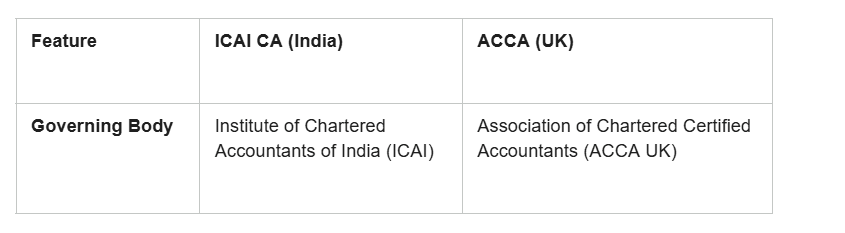
Choosing between the Institute of Chartered Accountants of India (ICAI) CA and the Association of Chartered Certified Accountants (ACCA UK) is one of the most critical decisions for finance aspirants in India. In 2026, the global corporate landscape, driven by Global Capability Centers (GCCs) and cross-border financial reporting, has reshaped employer demand.
This guide provides a data-backed comparison of pass rates, financial investments, exam flexibility, global mobility, and salary trajectories to help you select the qualification aligned with your career goals.
Quick Verdict: ACCA vs CA at a Glance
For students and professionals seeking a concise comparison, the table below outlines the structural and operational differences between the two credentials.


Architectural & Philosophical Differences
Understanding the core purpose of each qualification is essential to aligning it with your professional ambitions:
ICAI CA (Built for Domestic Monopoly & Statutory Law): The Indian CA qualification is designed to create public accountants governed by domestic tax statutes, corporate law (Companies Act, 2013), and statutory auditing standards. Its primary legal power lies in the exclusive right to sign statutory audit reports and income tax filings within India.
ACCA UK (Built for Global Mobility & IFRS Mastery): ACCA is engineered for international corporate finance, financial management, and cross-border reporting. Built around International Financial Reporting Standards (IFRS) and International Standards on Auditing (ISA), ACCA equips professionals to manage corporate balance sheets across multinational jurisdictions without geographic constraints.
Deep Dive: Exam Flexibility & Pass Rate Reality
A major distinction between the two qualifications lies in their exam delivery frameworks and assessment philosophies.

CA Path: [ Foundation ] ➔ [ Inter Group 1 + 2 ] ➔ [ 2-Yr Articleship ] ➔ [ Final Group 1 + 2 ]
ACCA Path: [ Applied Knowledge ] ➔ [ Applied Skills ] ➔ [ Strategic Professional ] (Pass paper-by-paper)
The CA Group Rule Trap
ICAI requires candidates to clear exams in "Groups" of 3 to 4 papers simultaneously. To pass a group, a candidate must secure a minimum of 40% in individual papers and a 50% aggregate overall.
The Penalty System: Failing even a single paper by one mark can force a candidate to re-sit all 3 or 4 papers in that group during the next six-month attempt, regardless of high scores achieved in the remaining subjects. This structural constraint often leads to extended study cycles for CA aspirants.
ACCA’s Flexible On-Demand Model
ACCA operates on a paper-by-paper progression system across four quarterly exam windows (March, June, September, and December).
Computer-Based Testing (CBT): On-demand CBTs are available for initial papers, with session-based CBTs for advanced modules.
No Group Penalty: If a candidate passes 3 papers and fails 1, the passed papers are retained permanently. The student only re-sits the failed paper in the next quarter.
Strategic Professional Focus: Despite higher global pass rates (~40–50%), ACCA is not "easy." Advanced modules like Strategic Business Leadership (SBL) and Advanced Audit and Assurance (AAA) rely heavily on complex case studies, strategic decision-making, and practical business scenarios rather than rote memorization.
The Global Job Market & GCC Surge in India
The choice between CA and ACCA depends heavily on where you intend to build your career.
1. The Rise of Global Capability Centers (GCCs) in India
India has become a major hub for GCCs, with thousands of multinational corporations establishing centralized finance operations in cities like Bengaluru, Hyderabad, Gurgaon, Mumbai, and Pune.
These GCCs manage financial consolidation, global taxation, financial planning and analysis (FP&A), and internal audit for parent entities in the US, UK, Europe, and Asia-Pacific. Because these entities report under IFRS or US GAAP, employers actively recruit ACCA professionals alongside CAs for their specialized knowledge in international standards.
2. Overseas Career Prospects
Middle East / GCC Region (Dubai, Qatar, Saudi Arabia): Strong demand for both CAs and ACCAs. ACCA candidates often adjust quickly due to the widespread application of IFRS in UAE commercial operations.
United Kingdom & Europe: ACCA offers direct recognition, local statutory audit pathways, and work authorization opportunities
Australia & Canada: ACCA maintains mutual recognition agreements and advanced pathways with regional professional bodies (such as CPA Australia).
Financial Investment & Cost Comparison
Evaluating the tuition and regulatory costs is critical when planning your educational investment.
Currency Note: Fees for ICAI are billed in Indian Rupees (INR), whereas ACCA charges standard registration, subscription, and examination fees in British Pounds (GBP). Exchange rate fluctuations can affect total ACCA costs.
ICAI CA Total Cost: ₹2,00,000 – ₹4,00,000 (Lower upfront fees + stipend offsetting)
ACCA UK Total Cost: ₹3,00,000 – ₹6,00,000 (Subject to GBP exchange rate & coaching choice)
ICAI CA Investment: Registration fees across Foundation, Inter, and Final, combined with coaching and training modules, typically range between ₹2,00,000 and ₹4,00,000. The mandatory 2-year articleship stipend helps offset a significant portion of these costs.
ACCA UK Investment: Total costs—including initial registration, annual subscription fees, GBP exam fees, and comprehensive coaching—range from ₹3,00,000 to ₹6,00,000. Candidates who qualify for exemptions (e.g., via B.Com or CA Inter) reduce their total exam fee burden substantially.
Exemption Roadmap & The "Power Combo" (CA + ACCA)
Candidates with prior academic qualifications do not need to take all 13 ACCA papers. ACCA provides exemptions based on existing credentials.
B.Com / M.Com Graduates: Exempt from up to 4 papers (Knowledge Level + Law).
CA Inter Cleared Candidates: Exempt from up to 6 papers (Applied Knowledge + select Applied Skills).
Fully Qualified ICAI CAs: Exempt from 9 out of 13 papers. Qualified CAs need to take only 4 Strategic Professional papers (SBL, SBR, and 2 Optionals) to earn the ACCA designation.
The Dual-Qualification Pathway
Combining both credentials—earning the ICAI CA for Indian statutory authority and ACCA for global IFRS expertise—creates a competitive profile. This dual credential opens doors to executive roles in Big 4 consulting, international FP&A, and cross-border M&A advisory.

Persona-Based Decision Tree
Are you choosing between CA and ACCA?
├── Target: Statutory Audit / Tax Law in India? ➔ Choose ICAI CA
├── Target: Global Mobility / IFRS / GCCs / Big 4? ➔ Choose ACCA
├── Dropped out of CA Inter / Stuck in exam loops? ➔ Pivot to ACCA (Claim 6 exemptions)
└── Already a Qualified ICAI CA? ➔ Take the 4-paper ACCA Fast Track
Class 12 Commerce Students: If your goal is a rapid, flexible entry into multinational finance within 2 to 3 years, ACCA offers a structured path alongside your undergraduate degree. If you intend to practice statutory audit in India, pursue ICAI CA.
CA Inter Candidates or Dropouts: If you are delayed by CA group attempts, pivoting to ACCA allows you to claim up to 6 paper exemptions and complete a globally recognized qualification without losing prior academic progress.
B.Com / M.Com Graduates: ACCA provides a direct route to bypass entry-level operational roles and qualify for strategic finance positions in Big 4 firms and GCCs within 18 to 24 months.
Qualified CAs: Completing the remaining 4 Strategic Professional papers of ACCA expands your portfolio for global leadership roles and overseas relocation.
High-Authority Strategic References
To verify exemptions, pass rates, and corporate hiring trends, refer to the official resources below:
ICAI Official Scheme of Education: Review updated syllabus guidelines and training rules at ICAI Official Portal.
ACCA Global Exemption Framework: Verify paper exemptions using the ACCA Global Exemption Calculator.
GCC & Corporate Hiring Insights: Track demand trends for IFRS professionals in Big 4 whitepapers published by Deloitte Insights and EY Global.
Frequently Asked Questions (FAQs)
1. Can an ACCA sign statutory audit reports in India?
No. Under the Companies Act, 2013, only a qualified Chartered Accountant registered with the Institute of Chartered Accountants of India (ICAI) holds legal signing authority for Indian statutory audits. However, ACCAs lead internal audits, corporate finance, financial reporting, and management consulting engagements within Indian companies and multinational GCCs.
2. Is ACCA recognized in India for Big 4 jobs?
Yes. All Big 4 firms in India (Deloitte, EY, PwC, KPMG) actively recruit ACCA professionals. They deploy ACCA members extensively within their audit, risk advisory, IFRS technical, deal advisory, and global delivery arms that serve international clients.
3. How many papers in ACCA are exempt for a qualified Indian CA?
A fully qualified ICAI Chartered Accountant receives 9 exemptions out of 13 papers in the ACCA qualification. To achieve ACCA membership, a CA must pass only 4 papers at the Strategic Professional level: Strategic Business Leader (SBL), Strategic Business Reporting (SBR), and two elective papers.
4. Is CA better than ACCA for getting a job in Dubai or the UK?
For the UK, ACCA holds a clear advantage due to direct recognition by regulatory bodies, statutory audit rights, and alignment with local employment frameworks. In Dubai and the broader GCC region, both qualifications are valued. CA is well-regarded in domestic finance teams, while ACCA is widely preferred by multinational firms operating under IFRS.
5. What happens if I fail an ACCA exam versus a CA exam group?
If you fail an ACCA paper, you re-sit only that specific subject during any of the four quarterly exam windows. Your passing scores in other papers remain valid indefinitely. Conversely, in the ICAI CA system, failing a single subject in a group typically requires you to re-attempt all subjects within that group, unless you meet specific exemption thresholds (scoring 60%+ in individual subjects).
Accelerate Your Global Finance Career with ADGA
Navigating professional finance qualifications requires clear guidance, structured preparation, and practical insight. Amit Dharaniya Global Academy (ADGA) offers personalized mentorship designed to turn ambitious students into globally certified professionals.
Customized Learning Pathways: Choose from flexible offline, online, or hybrid modules structured around your schedule.
Expert Mentorship: Learn directly from seasoned faculty with extensive domain expertise in IFRS, financial reporting, and strategic audit.
Daily Doubt-Clearing & Exam Prep: Access consistent academic support, exam strategies, and computer-based mock assessments.
Career & Placement Support: Benefit from dedicated interview prep and recruitment connections across Big 4s and leading MNCs.
Ready to choose the right path for your career? Contact ADGA Today to schedule a personalized counseling session with our senior education strategists.
🚀 Ready to Start Your ACCA Journey?
Join Amit Dharaniya Global Academy today and get access to world-class mentorship, flexible learning, and guaranteed placement support.
Book Demo