ACCA vs CFA: Which Professional Course Pays More in India in 2026?
9/16/2026
When ambitious finance students and early-career professionals plan their professional roadmap, one debate stands out: ACCA (Association of Chartered Certified Accountants) versus CFA (Chartered Financial Analyst).
Both designations enjoy global prestige, but they serve fundamentally different functions in the corporate world. ACCA is the global gold standard for accounting, audit, financial reporting, taxation, and corporate governance. CFA, on the other hand, is the premier credential for investment management, equity research, portfolio management, and corporate finance.
Choosing between them based solely on starting figures can be misleading. Salary trajectories in finance depend not only on base pay, but on fixed versus variable compensation structures, industry margins, risk profiles, and corporate ceilings.
At Amit Dharaniya Global Academy (ADGA), under the leadership of Amit Dharaniya, we guide finance aspirants through these choices, equipping them with the qualifications and practical skills needed for top-tier corporate placement.
This 2026 financial report analyzes the compensation, return on investment (ROI), career growth, and market demand for ACCA and CFA professionals in India.
1. Experience & Milestone Salary Matrix (2026)
Compensation structures differ significantly between accounting/reporting (ACCA) and investment management (CFA). While ACCA roles offer high fixed base salaries, predictability, and steady career progression, CFA roles in front-office finance often feature higher variable performance bonuses tied to deal sizes and portfolio returns.
Career Milestone / Qualification Level | ACCA Pathway: Fixed Base CTC (INR) | ACCA: Typical Variable Bonus | CFA Pathway: Fixed Base CTC (INR) | CFA: Typical Variable Bonus | Primary Roles & Verticals |
Entry Level (ACCA Affiliate / CFA Level 1) | ₹5.5 LPA – ₹8.5 LPA | 5% – 10% | ₹5.0 LPA – ₹8.0 LPA | 5% – 15% | • ACCA: Audit Associate, Tax Analyst, Financial Reporting • CFA: Research Associate, Junior Data Analyst, Risk Analyst |
Mid-Level (ACCA Member 3–5 yrs / CFA Level 2–3) | ₹10.0 LPA – ₹16.0 LPA | 10% – 15% | ₹12.0 LPA – ₹20.0 LPA | 15% – 30% | • ACCA: Senior Auditor, Financial Controller, Statutory Reporting Lead • CFA: Senior Equity Analyst, Investment Banking Associate, Portfolio Analyst |
Senior Level (ACCA 7–10 yrs / CFA Charterholder) | ₹18.0 LPA – ₹28.0 LPA | 15% – 25% | ₹22.0 LPA – ₹40.0 LPA | 25% – 60% | • ACCA: Finance Manager, Senior Manager Audit, IFRS Consultant • CFA: Portfolio Manager, VP Investment Banking, Risk Director |
Executive / Leadership (Director, Partner, MD, CFO) | ₹35.0 LPA – ₹75.0+ LPA | 20% – 40% + Equity | ₹50.0 LPA – ₹1.2+ Cr | 40% – 150%+ (Carried Interest) | • ACCA: Chief Financial Officer (CFO), Audit Partner, Group Controller • CFA: Managing Director (IB), Chief Investment Officer (CIO), Hedge Fund Lead |
2. Role-Wise Pay Breakdown: Audit/Reporting vs. Investment Management
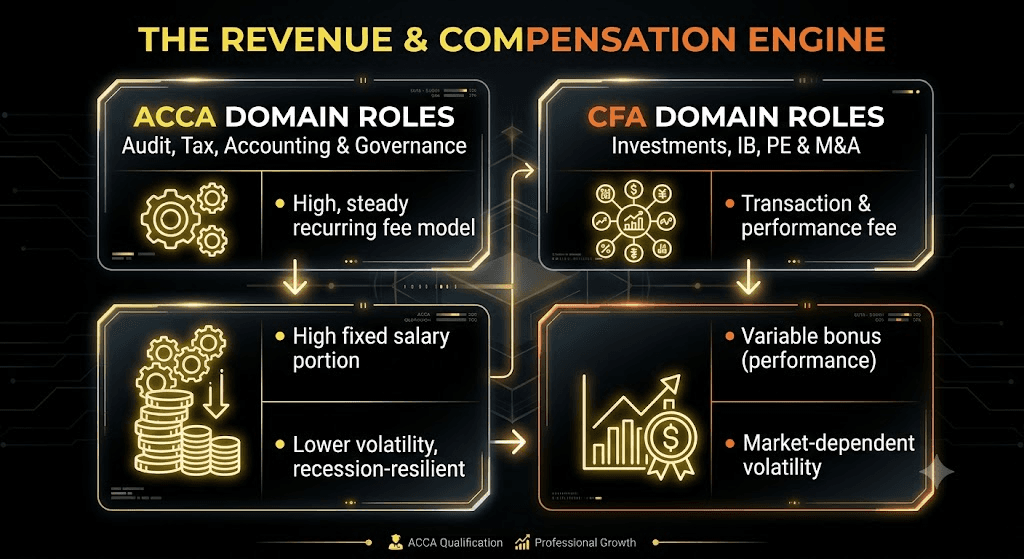
To understand why pay structures diverge, we must look at the revenue models of the sectors hiring ACCA and CFA professionals.
┌─────────────────────────────────────────────────────────────────────────┐
│ THE REVENUE & COMPENSATION ENGINE │
├───────────────────────────────────────┬─────────────────────────────────┤
│ ACCA DOMAIN ROLES │ CFA DOMAIN ROLES │
│ Audit, Tax, Accounting & Governance │ Investments, IB, PE & M&A │
├───────────────────────────────────────┼─────────────────────────────────┤
│ • High, steady recurring fee model │ • Transaction & performance fee │
│ • High fixed salary portion │ • Variable bonus (performance) │
│ • Lower volatility, recession-resilient│ • Market-dependent volatility │
└───────────────────────────────────────┴─────────────────────────────────┘
Domain A: ACCA-Dominant Roles (Accounting, Audit, Taxation & Governance)
ACCAs thrive in Big 4 accounting firms (EY, PwC, Deloitte, KPMG), multinational Global Capability Centers (GCCs), Shared Service Centers, and listed Indian corporates.
Statutory Audit & Financial Reporting (IFRS/Ind AS): ACCA affiliates and members lead global audit engagements and consolidation schedules. Fresher salaries at Big 4 offshore delivery centers range from ₹6.0 LPA to ₹8.5 LPA.
Corporate Controllership & Financial Planning (FP&A): Mid-level ACCAs managing group reporting or FP&A divisions at MNCs in hubs like Gurgaon, Bangalore, or Mohali command salaries between ₹12.0 LPA and ₹18.0 LPA.
Risk Advisory & Internal Audit: Advisory arms pay strong fixed base salaries with steady year-on-year raises.
Key Takeaway for ACCA: Highly predictable salary growth, low vulnerability to economic downturns, and immediate entry-level demand across corporate India.
Domain B: CFA-Dominant Roles (Investments, Corporate Finance & Dealmaking)
CFAs dominate investment management, private equity (PE), venture capital (VC), equity research, and investment banking (IB).
Investment Banking & M&A Advisory: Front-office IB roles at global bulge-bracket banks (Morgan Stanley, J.P. Morgan, Goldman Sachs) or domestic investment banks pay entry base salaries of ₹12.0 LPA to ₹20.0 LPA, but variable bonuses during strong market cycles can equal 50% to 100%+ of the base pay.
Equity Research & Asset Management (AMCs): Equity analysts evaluating listed equities earn ₹8.0 LPA to ₹15.0 LPA at mid-tier firms, scaling beyond ₹30.0 LPA as senior analysts or Portfolio Managers.
Private Equity & Venture Capital: High-end PE/VC firms offer base salaries paired with "carried interest" (a percentage share of fund profits), driving senior compensation into executive tiers.
Key Takeaway for CFA: Higher salary ceiling and performance bonuses, balanced by higher entry barriers and market volatility.
3. Financial ROI: Total Investment vs. Payback Period (2026)
Calculating the Return on Investment (ROI) requires evaluating total upfront expenditure against starting salary expectations.
Forex Assumptions for 2026 Calculations: £1 GBP ≈ ₹110 INR | $1 USD ≈ ₹85 INR.
ACCA Total Financial Outlay (Direct Registration to Membership)
Expense Head | Currency Cost | Cost in INR (₹) |
Initial ACCA Registration + Annual Subscription | ~£200 | ~₹22,000 |
Exemption Fees (Assuming 4–5 exemptions for B.Com) | ~£370 – £480 | ~₹41,000 – ₹53,000 |
Exam Fees (8 Remaining Knowledge, Skills & Professional Papers) | ~£1,100 | ~₹1,21,000 |
Approved Study Materials & ADGA Coaching | — | ~₹60,000 – ₹90,000 |
Total Estimated ACCA Investment | — | ₹2,44,000 – ₹2,86,000 |
Average Starting Salary (ACCA Affiliate / B.Com): ~₹6,50,000 per annum (₹6.5 LPA)
Estimated Payback Period: 4.5 to 5.5 months of starting gross salary.
CFA Total Financial Outlay (Level 1, Level 2 & Level 3)
Expense Head | Currency Cost | Cost in INR (₹) |
CFA Program One-Time Enrollment Fee | $350 | ~₹29,750 |
Level 1, 2, & 3 Exam Registration Fees (Early-Bird Rates) | $3,600 ($1,200 × 3) | ~₹3,06,000 |
Curriculum Prep Books & ADGA Coaching Support | — | ~₹70,000 – ₹1,000,000 |
Total Estimated CFA Investment | — | ₹4,05,750 – ₹4,35,750 |
Average Starting Salary (CFA Level 1 / Level 2 Cleared Fresher): ~₹6,00,000 to ₹7,50,000 per annum (₹6.0 – ₹7.5 LPA)
Estimated Payback Period: 7 to 9 months of starting gross salary.
ROI & PAYBACK TIMELINE
ACCA Outlay: ~₹2.5L | Payback: 4.5 – 5.5 Months [██████░░░░]
CFA Outlay: ~₹4.2L | Payback: 7.0 – 9.0 Months [█████████░]
4. Decision Matrix: Which Course Fits You Best?
Selecting the right credential depends on your academic background, mathematical comfort, financial budget, and long-term career aspirations.
Decision Factor | ACCA (Association of Chartered Certified Accountants) | CFA (Chartered Financial Analyst) |
Eligibility Criteria | Flexible Entry: Can start immediately after 12th standard (Commerce/Science). Exemption pathways available for B.Com, BBA, and CA students. | Graduation Required: Must be in the final year of a bachelor's degree or have completed graduation to sit for Level 1. |
Quantitative / Math Intensity | Moderate: Focuses on business logic, accounting standards, financial analysis, tax, and law. Basic arithmetic and formula application required. | High: Heavy emphasis on quantitative methods, financial econometrics, statistical testing, calculus concepts, and derivative valuation. |
Global Pass Rates (Avg) | 40% – 50% across Knowledge and Skills levels; 35% – 45% at Strategic Professional level. | 36% – 39% for Level 1; 44% for Level 2; 48% for Level 3. Highly competitive global curve. |
Primary Skill Outcome | Master of financial statement preparation (IFRS), global audit execution, tax planning, corporate risk, and financial control. | Master of security analysis, business valuation models, portfolio theory, alternative investments, and financial risk engineering. |
Job Market Stability | Very High: Every corporation, Big 4, and GCC requires accountants and auditors regardless of economic conditions. | High Growth / Volatile: Highly lucrative during economic expansions; recruitment slows during market downturns. |
5. Frequently Asked Questions (FAQs)
1. Does a CFA Charterholder earn more than an ACCA Member in India?
At senior levels (8+ years of experience), a CFA Charterholder working in front-office roles—such as investment banking, private equity, or portfolio management—often earns a higher total compensation package than an ACCA Member, primarily due to large variable bonuses and carried interest. However, at entry and mid-levels, base salaries for ACCAs and CFAs are comparable, with ACCA offering higher job stability across corporate sectors.
2. Can I pursue both ACCA and CFA together in India?
Yes. Pursuing both designations creates a dual-threat skill set: you gain deep mastery over financial statement reporting (ACCA) alongside advanced valuation and corporate finance capabilities (CFA). Many finance professionals complete their ACCA during or right after graduation, build 2–3 years of work experience, and then enroll in the CFA Program to transition into corporate finance or deal advisory roles.
3. What is the starting salary for a CFA Level 1 cleared fresher in India?
A fresher who has cleared CFA Level 1 along with a relevant undergraduate degree (B.Com/BBA/B.Sc Finance) can expect a starting salary between ₹5.0 LPA and ₹7.5 LPA in research analyst, risk support, or corporate finance roles across Indian financial centers.
4. Do Big 4 accounting firms prefer ACCA or CFA candidates?
It depends on the service line. For Statutory Audit, Global Reporting, IFRS Compliance, Risk Advisory, and International Tax, Big 4 firms explicitly prefer ACCA candidates. For Valuations, M&A Deal Advisory, Financial Modeling, and Corporate Strategy, Big 4 teams actively recruit CFA candidates.
6. Official Resources & Verification Links
To review syllabus frameworks, fee schedules, and registration deadlines directly, visit the official portals:
ACCA Global Official Portal: Review qualifications, syllabus structures, and student resources on the ACCA Global Official Website.
CFA Institute Official Portal: Verify exam windows, curriculum topics, and candidate guidelines on the CFA Institute Official Website.
National Career Service (India): Track national employment trends and sector-wise demand reports on the Ministry of Labour & Employment NCS Portal.
Build Your Global Finance Career with Amit Dharaniya Global Academy (ADGA)
Whether your goal is to master financial reporting with ACCA or conquer investment management with CFA, passing these international exams requires structured preparation, expert mentorship, and practical training.
At Amit Dharaniya Global Academy (ADGA), we bridge the gap between academic study and real-world corporate execution. Led by Amit Dharaniya, one of India's premier finance trainers, ADGA offers comprehensive coaching programs designed to help you clear your exams on the first attempt while preparing you for top-tier corporate placements.
Why Study at ADGA?
Expert Leadership: Direct mentorship from industry veterans and qualified corporate trainers.
Exam-Oriented Prep: Comprehensive coverage of BPP/Kaplan study materials, topic-wise practice banks, and mock exams with personalized feedback.
Bridge Modules: Hands-on training in financial modeling, IFRS applications, and practical accounting tools to ensure job readiness.
Placement & Resume Support: Direct interview preparation, resume enhancement, and referral assistance for Big 4 firms, GCCs, and financial institutions across India.
🚀 Ready to Start Your ACCA Journey?
Join Amit Dharaniya Global Academy today and get access to world-class mentorship, flexible learning, and guaranteed placement support.
Book Demo