60-Day ACCA December 2026 Exam Strategy: Complete Study Plan & Section C Hacks
10/6/2026
60-Day ACCA December 2026 Exam Strategy: Study Plan, Revision Timetable & Section C Hacks
With the ACCA December 2026 exam session running from 7–11 December 2026, standing on the 60-day mark is the exact inflection point where average candidates get overwhelmed—and successful candidates shift into high gear. Preparing for ACCA Applied Skills or Strategic Professional papers is not about how many hours you spend staring at a textbook; it is about how rapidly you transition from passive reader to active exam-room solver.
60 days provides precisely 8 weeks: enough runway to digest the full syllabus, build muscle memory on the official Computer Based Exam (CBE) interface, and master the technical precision required for Section C constructed response questions. If you start today with a structured, aggressive roadmap, passing on your first attempt is completely within your control.
Level Up Your Preparation: Looking for structured, expert-led guidance to accelerate your study plan? Explore expert courses by Amit Dharaniya on amitdharaniya.com or jump straight into the full course library at amitdharaniya.com/courses to complement your 60-day strategy.
This comprehensive guide breaks down your 60-day battle plan into three core phases, provides a plug-and-play revision timetable, and reveals crucial Section C hacks designed to extract every available mark from ACCA examiners.
Phase 1 (Days 1–25): Syllabus Coverage & High-Yield Focus
The biggest trap in ACCA preparation is spending 40 days reading every page of a 600-page study text word-for-word. Phase 1 is about tactical coverage: absorbing high-yield concepts quickly while establishing immediate context through practice.
1. Leverage Official Core Resources
Start by grounding your learning in the official ACCA Study Hub alongside approved content provider materials from Kaplan or BPP.
ACCA Study Hub: Use this digital platform for concise topic summaries, official quizzes, and interactive flashcards. It highlights key examinable terms without the fluff.
Approved Textbooks/Kits (Kaplan/BPP): Use textbooks primarily as reference guides for complex topics (such as Consolidated Financial Statements in FR, WACC calculations in FM, or Variance Analysis in PM). Do not read passively—read with a pen in hand, solving illustration examples as you go.
2. Apply the 80/20 Rule (Pareto Principle)
Not all syllabus chapters carry equal weight. Focus first on core topics that consistently generate 15–20 mark questions in Section B and Section C.
Performance Management (PM): Focus heavily on Transfer Pricing, Decision Making (Limiting Factors), and Standard Costing/Variances.
Financial Reporting (FR): Prioritize Group Accounting (Consolidated Balance Sheet/Profit or Loss) and single-entity financial statement preparation (IAS 1, IAS 7, IFRS 15, IFRS 16).
Financial Management (FM): Master Investment Appraisal (NPV, IRR, Payback) and Cost of Capital (WACC, CAPM), which together consistently constitute a major portion of Section C.
Audit and Assurance (AA): Focus on Audit Risk & Response, Internal Controls, and Substantive Procedures.
3. Integrated End-of-Chapter Practice
Never complete a chapter without immediately attempting its corresponding end-of-chapter test or exam kit questions. Studying a concept without testing it within 24 hours results in an 80% loss of retention. Learn a concept, solve 3–5 objective test (OT) questions on that concept, and move forward.
Need Structured Learning Paths?
If you struggle with self-study or complex technical concepts, check out the specialized courses and step-by-step video training offered by Amit Dharaniya. Browse available programs at amitdharaniya.com/courses to fast-track your understanding of high-yield exam topics.
Phase 2 (Days 26–45): Question Practice & Active Recall
By Day 26, put your textbook aside. Passive reading ends here. Phase 2 transitions your brain into active recall and continuous question practice using your revision kit (Kaplan or BPP) and the ACCA Practice Platform.
1. The "1.8 Minutes Per Mark" Golden Rule
Time management is the single largest reason qualified candidates fail ACCA exams. Every ACCA exam awards 100 marks across 180 minutes (3 hours). This gives you exactly 1.8 minutes per mark.
TimeAllowed(minutes)=Marks1.8
10-Mark Section C Question: 18 minutes maximum.
20-Mark Section C Question: 36 minutes maximum.
2-Mark OT Question: 3.6 minutes maximum.
During Phase 2, never solve a question without a running timer. When your time limit for a question expires, stop, mark your work, and examine where your time went.
2. Review Examiner Reports Religiously
Examiner reports are goldmines of free marks. Available on the official ACCA website, these documents outline exactly what real candidates did wrong in past sittings.
Pay attention to recurring feedback, such as: "Candidates failed to apply their answer to the scenario," or "Candidates wasted time performing unnecessary calculations."
Compile a personal "Mistake Journal" listing the common traps identified by examiners so you avoid duplicating them under exam pressure.
Phase 3 (Days 46–60): Mock Exams & Exam Condition Sprints
The final 15 days replicate the real exam environment. Your goal is to build physical and mental endurance for the 3-hour sitting while polishing presentation skills.
1. Execute 3 Full-Length Mock Exams
Log onto the official ACCA Practice Platform and sit at least 3 full-length mock exams under strict, uninterrupted exam conditions:
Mock 1 (Day 48): ACCA Specimen Exam on the Practice Platform.
Mock 2 (Day 52): Pre-Dec 2026 Mock Paper / Official Past Exam.
Mock 3 (Day 56): ACCA Official Practice Exam 1 or 2.
2. The 3-Step Mock Debrief Routine
Taking the mock exam is only 50% of the value; the remaining 50% lies in how you debrief it. Spend at least 2 hours reviewing every completed mock using this diagnostic framework:
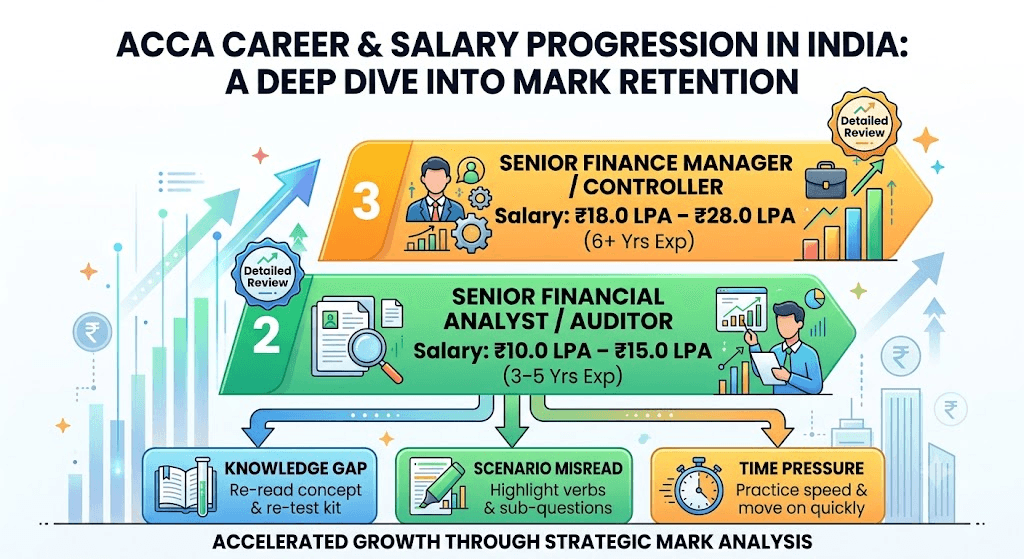
┌──────────────────────────────┐
│ Analyze Every Lost Mark │
└──────────────┬───────────────┘
│
┌───────────────────────┼───────────────────────┐
▼ ▼ ▼
┌──────────────────┐ ┌──────────────────┐ ┌──────────────────┐
│ Knowledge Gap │ │ Scenario Misread │ │ Time Pressure │
│ Re-read concept │ │ Highlight verbs │ │ Practice speed & │
│ & re-test kit │ │ & sub-questions │ │ move on quickly │
└──────────────────┘ └──────────────────┘ └──────────────────┘
Knowledge Gap: Did you lose marks because you didn't know the formula or rule? (Action: Re-read that specific topic in your Study Hub summary).
Misread Requirement: Did you calculate total cost instead of cost per unit, or describe when asked to evaluate? (Action: Train yourself to highlight verbs in the prompt).
Time Pressure: Did you run out of time on Section C because you over-calculated in Section A? (Action: Enforce the strict 1.8 minutes/mark cutoff).
Section C Mastery: Spreadsheet & Word Processor Hacks
Section C (Constructive Response) accounts for 40% to 100% of total marks depending on your exam level. Mastering the built-in spreadsheet and word processor tools on the ACCA CBE interface guarantees high-margin marks.
1. The "1 Point = 1 Mark" Rule for Narrative Questions
Examiners do not award marks for long-winded essays. In narrative answers (e.g., Audit Risks, Performance Analysis, Financial Analysis):
1 fully explained point = 1 mark.
Structure each paragraph using the PEEL Method:
Point: State the issue directly.
Explanation: Explain why it matters or how it applies.
Effect: Explain the financial or operational impact on the scenario company.
Link: Link back to the requirement or standard.
2. Formatting Rules for Easy Marking
Examiners mark hundreds of pages daily on screen. Make your script effortless to mark:
Use Bold Headings to separate different parts of your answer.
Leave a blank line between paragraphs.
Use short, punchy paragraphs (2–3 sentences max).
Use numbered or bulleted lists for distinct points.
3. Spreadsheet Formula Rules: Never Type Static Numbers
When completing financial models, cash flow forecasts, or consolidation working tables in the CBE spreadsheet:
Always use live formulas: Write =SUM(B2:B10), =B5*C5, =PV(...), or =NPV(...) directly inside cells.
Why? The examiner clicks into your cells when reviewing your script. If your final calculated figure is incorrect due to an earlier arithmetic slip, you will still receive Own-Figure Marks (OFM) if your formula logic is correct! If you type a static number without a formula, you lose all marks.
4. How to Dissect Command Verbs
Tailor the depth of your written answer directly to the verb used in the question stem:
Verb | What the Examiner Demands | Example Response Approach |
Calculate | Produce a numerical figure showing clear workings. | Show spreadsheet formulas or step-by-step arithmetic. |
Identify / State | Name or highlight the factor directly from the scenario. | Single sentence stating the fact clearly. |
Describe | State what something is and give key details about its properties. | 2–3 sentences covering nature, characteristics, and application. |
Discuss | Explore multiple sides of an issue (pros vs. cons, causes vs. effects). | Balanced analysis presenting two distinct perspectives with scenario links. |
Evaluate | Make a critical judgment on value, effectiveness, or impact, concluding with a recommendation. | Full analysis detailing pros, cons, impact on stakeholders, and a final summary advice. |
The 60-Day Revision Timetable
This structured schedule assumes 2–3 hours of study on weekdays and 5–6 hours on weekends (approx. 18–22 hours/week).
Week | Focus / Phase | Daily Tasks (Mon – Fri) | Weekend Focus (Sat – Sun) | Target Weekly Hours |
Week 1 | Phase 1: Core Syllabus (50%) | Study Hub chapters + end-of-chapter OT quizzes (Topics A & B) | Heavy practice on core Section C calculation topics (e.g., Groups / Investment Appraisal) | 18 Hours |
Week 2 | Phase 1: Core Syllabus (80%) | Study Hub chapters + end-of-chapter OT quizzes (Topics C & D) | Complete 30 Section A & B kit questions under timed conditions | 18 Hours |
Week 3 | Phase 1: Syllabus Wrap-up | Finish remaining theoretical chapters; consolidate mistaked topics | Complete 2 full Section C questions on the ACCA Practice Platform | 20 Hours |
Week 4 | Phase 2: Focused Revision | Timed Section A & B question blocks (15 questions/day) from Revision Kit | Full Section C sprint: Solve 4 timed Section C questions; review answers against marking scheme | 20 Hours |
Week 5 | Phase 2: Advanced Question Practice | Target weak syllabus areas identified in Week 4; memorize formulas/standards | Section C sprint: Practice formatting and spreadsheet formulas in CBE Blank Workspace | 20 Hours |
Week 6 | Phase 3: Mocks & Debrief | Review Examiner Reports; practice weak OT topics under 1.8 min/mark constraint | Full Mock 1 on Practice Platform under strict exam conditions + 2-hour debrief | 22 Hours |
Week 7 | Phase 3: Mocks & Exam Sprints | Review Mock 1 errors; refine Section C narrative structure and typing speed | Full Mock 2 on Practice Platform + thorough debrief and mistake logging | 22 Hours |
Week 8 | Phase 3: Final Polish | Full Mock 3 (Mid-week); light review of core formulas, standards, and memory aids | Light revision only; review mistake log; test tech/system setups; rest before exam day | 15 Hours |
Frequently Asked Questions (FAQs)
1. Can I clear an ACCA Applied Skills paper in 60 days starting from scratch?
Yes, absolutely. 60 days (approx. 150–180 total study hours) is more than sufficient to pass an ACCA Applied Skills paper (such as PM, FR, AA, or FM) if you follow a structured plan. The key is to complete syllabus learning within the first 25 days and dedicate the remaining 35 days entirely to timed question practice on the official ACCA Practice Platform.
2. How many hours per day should I study for ACCA during a 60-day prep?
Aim for 2 to 3 hours on weekdays and 5 to 6 hours on weekend days. This yields roughly 20 hours per week, totaling 160+ hours over 60 days. Consistency matters far more than cramming: 2 focused hours every single day builds better retention than a 12-hour session once a week.
3. How do I improve my typing speed and presentation for Section C?
Do not practice Section C on paper or in standard Microsoft Word/Excel. Practice exclusively inside the ACCA CBE Practice Platform Workspace.
Aim for a typing speed of at least 30–40 words per minute.
Practice using standard spreadsheet shortcuts (Ctrl+C, Ctrl+V, =SUM, =PV).
Get comfortable using bold headings, clear bullet points, and short paragraphs to make your answers easy for examiners to read and mark.
4. Should I study using physical books or the official ACCA Practice Platform?
While physical textbooks (Kaplan or BPP) or the digital ACCA Study Hub are useful during Phase 1 for initial concept understanding, you must transition to the official ACCA Practice Platform for Phase 2 and Phase 3. The real ACCA exam is 100% computer-based; practicing in the exact interface you will face on exam day eliminates technical surprises, builds spreadsheet muscle memory, and significantly improves time management.
Master Your ACCA Journey with Amit Dharaniya
Taking on the December 2026 ACCA sitting requires clear strategy, time management, and expert guidance. If you want structured support, practical guidance, and premium learning materials to boost your confidence, check out the comprehensive courses taught by Amit Dharaniya.
Ready to elevate your performance?
Explore all available training modules and programs now at https://amitdharaniya.com/courses.
Key Takeaways for December 2026 Success
Stick to the 1.8-minute-per-mark rule to ensure you finish the exam.
Build your answers in the spreadsheet using live formulas to secure working marks even if your final answer is wrong.
Attempt at least 3 full mock exams on the ACCA Practice Platform before test week.
Execute this 60-day strategy with discipline, leverage expert course resources when you need extra support, and walk into your December 2026 exam with complete confidence!
🚀 Ready to Start Your ACCA Journey?
Join Amit Dharaniya Global Academy today and get access to world-class mentorship, flexible learning, and guaranteed placement support.
Book Demo